Hey Marketing Bestie,
Have you been in this meeting before? Someone says: “We should try TV ads.” Someone else starts debating whether TV “works.” Random budgets get tossed around. No one knows how to measure results.
Everyone nods. Nobody’s really confident. And there’s still no plan for TV. |
|
|
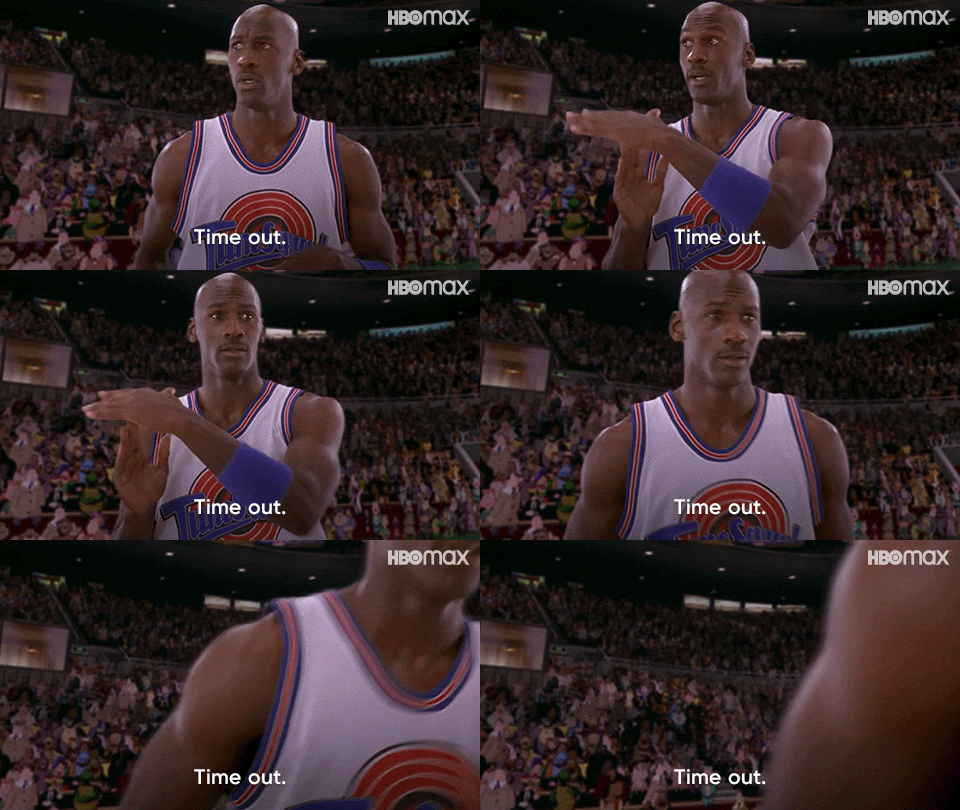
I have a theory: TV isn’t a channel to be debated anymore. It’s a Marketing Ops problem. And most of us never got a manual. (What else is new?) So I thought we’d take a quick TIME OUT to write down the rules. Presenting: The 5 Rules of the TV Game (if You Want to Avoid Wasting Budget) ⏱️
At the end of this, you’ll know: - how to avoid accidentally testing the wrong version of TV
- how to tell if TV is working
- how to test TV without guessing
Plus, the plays you need to know. I brought my clipboard and everything. Ready? *blows whistle* |
Rule #1: Know What Game You’re Playing |
Conversations about TV ads usually go sideways for 1 big reason: Everyone means something different when they say “TV.” 1 person means live sports.
Another means Hulu or Peacock.
Someone else means retargeting site visitors on a smart TV. Same word. Different games. Related, but different.
So, before you think about budgets or strategy, let’s get on the same page: |
🗣️ What counts as “TV”...from a Marketing POV? 📺 |
Broadcast and cable. Scheduled programming AND live events. Big reach, big awareness, usually lower costs for impressions (measured by CPMs). |
Ads delivered through apps on any smart TV you can binge your shows on. Still feels like “regular TV” to the viewer, but from an advertising POV? It’s got very different buying and measurement options.
Okay? So far so good. The confusion comes with what happens next: how you BUY the ads. |
Linear TV is (usually) bought directly.
Streaming TV can be bought in 2 (main) ways: |
(I’m keeping this simple for now, don’t @ me) |
🅰️ Programmatic streaming
If you’ve bought a bundle of display ads or other digital marketing placements at scale, this probably feels familiar.
- Audience targeting, faster iteration + clearer knobs to turn
- Retargeting plays that feel closer to digital, but on TV (like showing people TV ads based on their site visits)
🅱️ Direct streaming buys
This is where you buy through direct publisher relationships or managed buying. It’s more manual, and it’s for: -
Premium inventory access (like the biggest shows or channels)
- More control over where & when your ads show up
-
Different prices + inventory than on open marketplaces (like when you get a lower price on a fancy placement because you’re buying without a middleman)
ALL of this is “TV.” Each combo has tradeoffs.
The problems start when you expect the same results from different tools, instead of figuring out which 1 - or which combination of them - meets your goals. Let me explain. |
Rule #2: Access is the Competitive Advantage |
Once you know what game you’re playing, the question is: What PLAYS do you have access to? ❌🅾️
A lot of TV platforms are programmatic CTV only. Since programmatic is how a lot of us are used to buying digital ads, it makes TV more familiar & easy. But remember what I said about tradeoffs? This is that.
Programmatic also runs the risk of lower-quality inventory, and less visibility about where your ads run.
That doesn’t mean programmatic is bad - it’s still important! - it just gives you access to 1 slice of the whole TV pie. Especially if you’re new to TV, this narrow focus can be risky.
Because on TV, access decides what's possible.
The more access, the more plays you can run. Where your ads run, what placements you can get, how quickly you can learn and adjust.
Sometimes you need speed & flexibility. Other times you need premium placement & higher control. A mix. |
This is how Chime cracked TV using Tatari’s Convergent TV platform.
They ran both linear AND streaming TV in 1 place, so they got visibility into performance, and could hit their cost targets while also driving brand awareness.
Like MOST things in Marketing, the “right” play depends on your goal. So it helps to have all your options open. CONVERGENT-style. Get it? SO. Instead of saying “we’re testing CTV,” get into your play combos: -
“We’re using streaming TV for reach, and layering in programmatic retargeting for conversions”
- “We’re using linear TV for awareness, and measuring lift across the rest of our digital channels.”
Kaboom. Now you’re not debating whether TV “works” or not. You’re discussing whether your strategy matches your goal.
|
Rule #3: CPM is the Entry Fee, Not The Scoreboard |
^^^ If you remember 1 rule from this whole thing, make it this 1. I get why CPM is the headline in a lot of TV strategies.
For years, it was 1 of the only things advertisers could reliably see. You paid for reach. You got impressions. And you hoped the rest worked out. That’s changed. THANK GOODNESS.
Today, TV can be measured WAY beyond “what did it cost us to get on the field?” Everything that happens after that is the part you actually care about: - Did your ad change behavior?
- How long did it take to show up in your bottom line?
-
How did it affect the rest of your mix, like search & social performance?
On channels where responses are immediate, these gaps are kinda NBD. On TV, you can’t ignore them. ..….which calls for a quick timeout. |
Sorry, more vocab incoming |
|
|
A brief huddle on incrementality & timing: |
TV influence doesn’t always show up right away. Someone might see an ad on Monday, search for you Thursday, and convert a week later on a totally different channel Incrementality is basically the question: did that conversion happen BECAUSE of your ad, or was it going to happen anyway?
Timing + incrementality matters because if you don’t account for timing, TV’s impact either gets missed entirely or credited somewhere else, like to Meta or Google.
That’s how teams end up thinking TV “didn’t work,” when it actually did, just not on the same timeline as a click ad. Make sense? Okay, huddle over. BREAK 👏 |
|
|
Building a better scoreboard |
An ACTUALLY-useful TV scoreboard connects cost to outcome AND timing.
Tatari’s measurement approach does this by tackling the 2 questions every TV test creates: -
Did TV ads make anything happen?
- When can we expect to see the changes?
Without BOTH answers, you might scale the wrong thing, or shut TV down…right before it starts working. Depending on your goal, you can find these answers by looking at: - incremental lift
- cost per visit or acquisition (CPV/CPA)
- changes in branded search or site traffic
- more efficiency in other channels
The point isn’t to pick EVERY metric. Just the 1s that match your campaign’s job. TV gives you fewer clean shots, so learning design matters more than in digital. Okay, ready to start running real tests? |
Rule #4: Test TV Like a Modern Channel |
TV testing used to be 1-shot. Run a campaign.
Wait. 🤞
Decide.
But as TV measurement has improved through platforms like Tatari, testing TV now looks a lot more like testing any other channel: You run VARIATIONS. Which means you can learn faster, and scale what works. Change your creative, format, network/publisher placement, frequency.
Test them over time.
Let the winners show themselves. Then iterate, iterate, iterate.
That’s how to turn TV from a gamble into a real test & scale channel like any other. Now, let’s talk about layering TV with the rest of your mix. |
Rule #5: TV is a Team Sport |
TV rarely does its best work alone. It can show up in: - Branded search (the “wait, what was that brand?” Google search later that night)
- Site traffic (that spike in direct traffic with no obvious referrer)
- Conversion efficiency on every channel (paid search converting better, retargeting suddenly doing its job, the same ads converting faster because people already recognize you when they see them)
This doesn’t mean TV gets credit for everything - kinda the opposite. It means TV works best as 1 part of your whole mix. TV creates familiarity. It shortens decision cycles - so when people are ready to buy, you’re top of mind. And it makes the rest of your marketing work harder. |
Me explaining my media mix strategy |
Fun fact: this is also where programmatic plays a role. Especially with retargeting. Plus, it makes it easier to see TV’s downstream impact without forcing TV to do everything by itself.
That’s how attention compounds. Then, instead of asking “Did TV work?” the question becomes “Where did TV show up for us?” That’s a much more useful conversation.
I <3 teamwork. |
The 10-Minute TV Playbook |
Okay, team. Before you spend a buck on TV ads, run this checklist:
🏈 What game are we playing?
Linear, streaming, or a mix? 🏈 What access do we get with this plan?
What inventory and placements are actually on the table? 🏈 Is the TV tool we’re using going to give us all the levers we need?
Or do you need an option that meets your goals?
🏈 What is this campaign designed to do?
Create demand, capture it, learn something specific, or support the broader mix?
🏈 Where should impact show up?
Search, site traffic, foot traffic, conversions, efficiency elsewhere?
🏈 When should we expect to see it?
Same day, later in the week, or over a longer window? |
TV is ready for you to take the field. You’ve got the playbook to build on.
Access to multiple lanes. The tools to measure real impact. A plan that won’t lie to you. And the control to meet YOUR goals. That’s what Convergent TV is built for: clarity, without dumbing down. It’s how modern teams run new channels.
And it’s how Tatari helps brands like Tecovas, Vuori, and Fabletics get to real answers - and results - instead of more guesswork. 📖 Learn more about Tatari’s Convergent TV approach here. 🧠 Or (my suggestion) nab time for a personal walkthrough over here. |
Let me know if this helped you see TV as something you can run!
I hope your 2026 has fewer leaps of faith, more personalization for your goals, and more repeatable systems. (Those are easier to explain in the budget meetings.) See you on TV,
Daniel |
|
|
{if !profile.vars.marketingland_user_fitness && profile.vars.marketingland_user_fitness != false}Join 7,390 other marketing leaders in Marketingland
|
|
|
{/if}{if profile.vars.marketingland_user_fitness == true}{/if}Get your brand in front of 120,100+ marketing leaders. |
Workweek Media Inc.
1023 Springdale Road, STE 9E
Austin, TX 78721
Want to ruin my day? Unsubscribe. |
|
|
|