{if ftt_dorm_120 == true}Quick favor: Our records indicate that you aren’t opening this email. But records can be wrong. Please click here if you’d like to remain subscribed to Fintech Takes. |
|
|
{/if}
Happy Wednesday, Fintech Listeners! I hope your holidays have been splendid so far. And I hope that you have a little more free time this week because today’s podcast is an all-timer! — Alex | Was this email forwarded to you? |
|
|
3 BIG IDEAS FROM THE PODCAST |
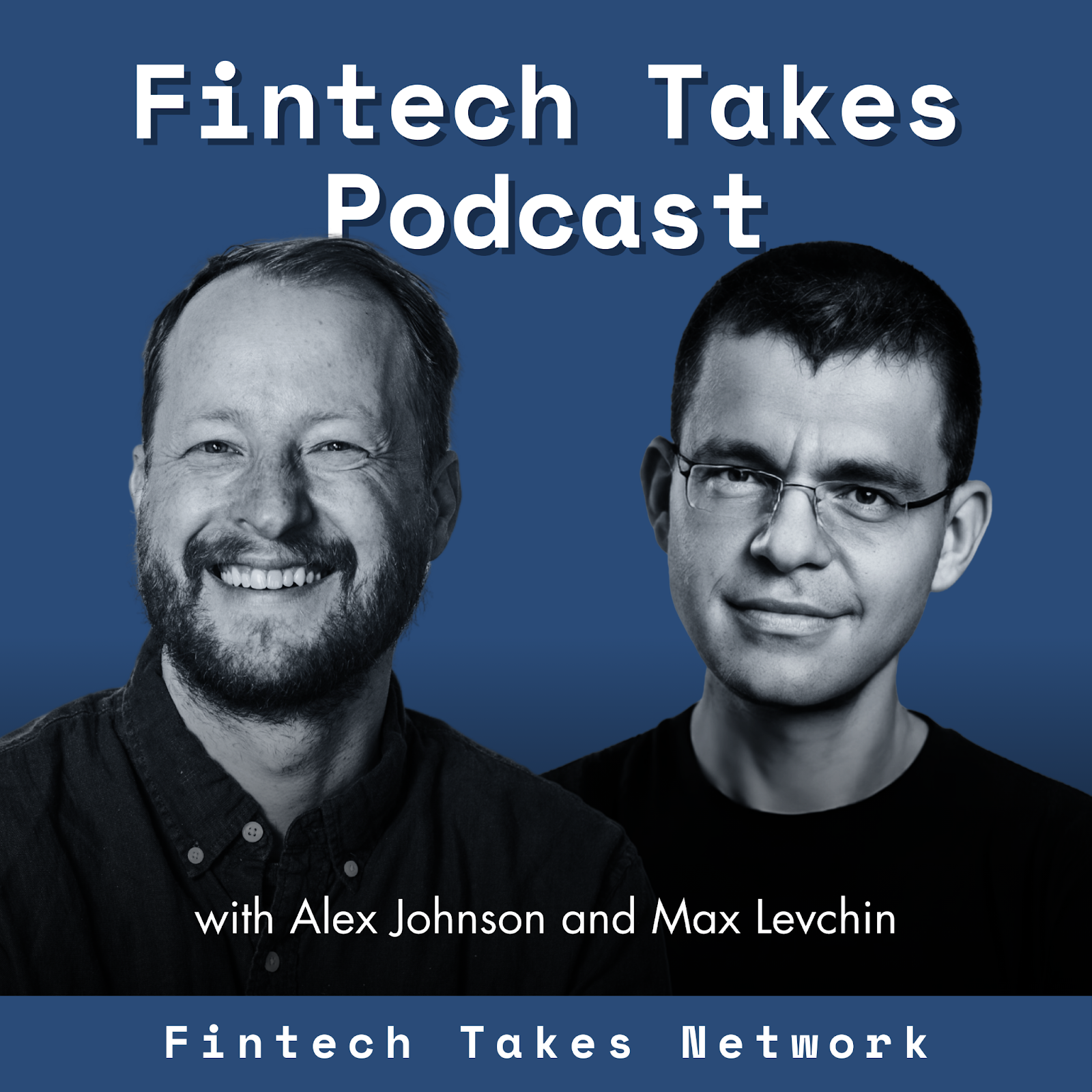
This week’s episode of the Fintech Takes podcast marks the launch of a new long-form interview format, which I’m calling Diving Deep. And in this episode, that’s exactly what we do with Max Levchin, co-founder and former CTO of PayPal and co-founder and the current CEO of Affirm.
I had the privilege of interviewing Max for two hours, which means we got to cover a lot of ground: the future of credit cards and BNPL, how to avoid the problem of chasing the right idea at the wrong time, why the best product might not be the one you meant to build, and how Affirm’s product philosophy was shaped by saying no early (and often). What stood out, though, wasn’t only Max’s fascinating stories (though there are many … this long-form format really encourages storytelling), but also how he consistently thinks in systems. Each decision closes a door. Each constraint lends a shape for what comes next. The throughline is incentives: design the system so the company only wins when the customer does, and culture has a fighting chance to scale. |
And read on below for my three big ideas… |
1. You Aren’t Your Customer |
Many fintech products plateau because they’re built by founders who mistakenly assume that most people want what they want.
This is what I like to call the 15% problem (originally coined in reference to the PFM market). It’s what happens when founders build for themselves and their friends. The product sees rapid early adoption from those whose temperament, context, and skills match the builder’s assumptions, then slams into a wall because, well, the other 85% live differently.
Max doesn’t call it the 15% problem (and he thinks 15% is way too generous), but he’s had the same observation. In fact, he calls it the Mint.com problem, because he also noticed it in the PFM space! The same 2% - 3% of folks who got excited about Mint, then get excited about a better Mint, and then the next one after that. New packaging, same audience. The cycle continues because the product is overfit to the builder’s brain. And in Max’s view, the problem is very common with engineers.
Engineers love puzzles. They build tools that reward focus and configuration. But financial decisions rarely happen in a calm, focused state. In real life, the user isn’t sitting quietly at a desk.
Max widens this into a theory of product design. He frames it as the difference between the default instincts of a software engineer and the discipline of a product designer.
Engineers, he says, build for themselves. Product designers do the opposite: they train themselves to embody the mind of someone who is not them.
Max uses the example of the parent who’s pushing a cart in a multi-lane checkout line, dealing with an overwhelmed cashier while holding a screaming baby in one hand as the line continues to grow.
At that moment, technical novelty (which engineers love) is a tax. Thought is a tax. Two hands is a tax.
A payment product built for that parent needs to be designed around an understanding of (and empathy towards) their constraints. And developing that understanding (and empathy) takes a lot of work! |
|
|
Max’s approach to customer research is quite anthropological. He’ll watch folks at Whole Foods (or other grocery stores in the cities he visits) to understand how checkout works, how people move, what they reach for, what breaks. He’s clocking shelf placement, what sits at eye level or below, and how often “self-checkout” still requires a human helper. I’m not sure how many executives who run commerce enablement or payment companies do this, but I’m betting it’s not a big number. |
|
|
2. Building for Next vs. Building for Now |
There’s a common belief in fintech (and tech, broadly) that the hard part is seeing what comes next.
Max argues the opposite; seeing the future is easy. That’s not the challenge. The challenge is building where people are already coalescing. As he says, Jules Verne imagined electric submarines at the turn of the 20th century. It’s easy to look at science fiction and realize that people routinely get the destination right. Some of the earliest versions of the company that eventually became PayPal were built on these correct-but-too-early predictions.
When the PalmPilot launched in 1996, Max saw it as the newest chapter in personal computing. That was enough to kickstart development. He initially focused on security infrastructure, assuming the PalmPilot would soon be full of sensitive data. But it wasn’t. There were fewer than 1 million devices sold at the time, mostly to nerds like Max (in his words!)
The market just wasn’t there yet.
The same was true of wireless device-to-device payments. Max and the team built a very technically sophisticated mobile money solution that allowed for peer-to-peer payments between people with PalmPilots.
But it ran into the same problem. Not nearly enough people owned PalmPilots to make this “money beaming” feature useful. But a lot of them did have email addresses. So, what started as a fallback in case the demo for the primary product (device-to-device money beaming) didn’t work ended up being the product that caught fire and turned PayPal into the company we know today: An easy way to send someone money on the web using their email address. Building a great product requires a balance between building for next and building for now. | 3. Great Products Require Constraints |
It was really interesting to talk to Max about his product development philosophy because a lot of the most consequential decisions that have shaped Affirm’s products were, in the early days, quite controversial.
Late fees are a great example. Many short-term lending products rely on them. Affirm decided early on that it would never have them, and that decision (and a rigid adherence to it over the years) has had a lot of positive outcomes for the company. As Max said, if you make money when people fail, you’re going to subconsciously design for failure. If you don’t have that revenue lever, your credit decisions have to be better. It forces the company to be better at underwriting.
That same logic showed up in Affirm’s checkout experience.
Early on, folks advised Max not to show Truth in Lending Act (TILA) disclosures during purchase flows, but he overruled them. Affirm showed them every time since that visibility made everything clear. Regulators liked it. Customers liked it. And that put Affirm on solid ground.
That same principle has shaped their approach to credit bureau reporting. Most BNPL providers avoid it. Affirm, on the other hand, has leaned into it. Most customers pay on time, Max explains. Not reporting their repayment data does them a disservice.
All of these constraints were structural decisions that removed optionality and pushed pressure upstream. If you couldn’t make money through fees, you had to lend more carefully. If you couldn’t hide the terms, you had to explain them. If you reported outcomes, you had to earn them.
In this way, building products that are aligned with the best interests of customers isn’t a choice; it’s an output. |
|
|
I didn’t get to catch up with either Miguel or Steve at Fintech Nerdcon in Miami last month, but I did get to listen to the two of them chat about fintech on Miguel’s podcast (which is excellent BTW), so that’s still a win! |
Two very smart fintech friends of mine, talking about fintech in accents that make them sound even smarter. I am annoyed. |
|
|
Thanks for the read! Let me know what you thought by replying back to this email. — Alex |
|
|
{if !profile.vars.fintech_takes_user_fitness && profile.vars.fintech_takes_user_fitness != false}Join 2,444 other finance and fintech leaders in the Fintech Takes Network |
|
|
{/if}{if profile.vars.fintech_takes_user_fitness == true}The conversation doesn't have to stop here
Keep learning and connecting in the Fintech Takes Network
EVENTS | FEED | LIBRARY | DIRECTORY
|
|
|
{/if}Get your brand in front of 55,000+ fintech and banking executives. |
Workweek Media Inc.
1023 Springdale Road, STE 9E
Austin, TX 78721
Want to ruin my day? Unsubscribe. |
|
|
|