{if ftt_dorm_120 == true}
Quick favor: Our records indicate that you aren’t opening this email. But records can be wrong. Please click here if you’d like to remain subscribed to Fintech Takes. |
|
|
{/if}{if membership_newsletter_optin == 'true'}
It looks like you’re a Fintech Takes Network member but haven’t been receiving the newsletter. We’ve added you to make sure you get the full experience (and if you’d rather not get it, you can always update your preferences at the bottom of this email). |
| |
{/if}Happy Monday, Fintech Takers!
Today’s newsletter comes to you from Salt Lake City, where the AI-Native Banking and Fintech Conference is kicking off tomorrow. I’m sure all of my answers about LLMs and generative AI in financial services will be answered. Yay!
Also, is Jayson Tatum coming back soon? No, right? This is absurd. I’m just going to wipe it from my brain. Anyway, fintech. Let’s talk fintech. - Alex |
Was this email forwarded to you? |
|
|
#1: Aim Small, Miss Small |
FICO is releasing a new set of analytic models: FICO, the eponymous credit score provider, announced three artificial intelligence language models for financial services firms on Tuesday: Focused Foundation Model, Focused Language Model and Focused Sequence Model.
In developing its own language models, FICO is offering an alternative to the large foundation models that have become popular in the industry, like OpenAI's ChatGPT, Anthropic's Claude, Google's Gemini. |
That alternative is what is known as “small language models” or “SLMs,” which have become increasingly common in financial services, as companies have to come to grips with the reality that large language models (LLMs) may never stop making shit up. Here’s how FICO’s Chief Analytics Officer, Scott Zoldi, frames the challenge of financial services providers building on top of LLMs:
According to FICO's Chief Analytics Officer Scott Zoldi, his team looked at the way banks were using generative AI, "where you use a pre-existing model that you have not trained yourself, and you don't actually understand what data is in there," he told American Banker. "And then you surround it with all kinds of tooling like retrieval augmented generation to try to get it to make a sensible decision."
With both LLMs and SLMs, the underlying architecture (transformer architecture) allows the models to make connections in large, unstructured datasets, which is useful in identifying more subtle or nuanced patterns that are harder to detect using traditional machine learning techniques. However, the degree of usefulness depends on how much data you use to train the model.
The frontier models that OpenAI, Google, and Anthropic build are trained on MASSIVE datasets. Think tens of billions of parameters. They are ridiculously expensive and time-consuming to train. They are expensive to operate. They are slow. They hallucinate frequently and will behave in ways that are difficult to predict or explain. However, on the positive side, they are extremely flexible and intelligent. They can do lots of different tasks.
If you train your model on fewer parameters, you can adjust these trade-offs. It can be faster and less expensive to build (up to 1,000x less expensive, according to FICO). Cheaper and faster to use. And less likely to screw up in the areas that they are trained on. However, in a general sense, these models are also dumber and less broadly capable.
Is this trade-off worth it? Does it make sense to build less capable models if you can get them to more consistently produce useful and trustworthy outputs? Does that actually add any value, above and beyond what today’s extremely sophisticated machine learning models can do? Well, FICO isn’t the first financial infrastructure company to try this. Stripe did something similar earlier this year and it does seem to have been worth it:
For years, Stripe has been using machine learning models trained on discrete features (BIN, zip, payment method, etc.) to improve our products for users. And these feature-by-feature efforts have worked well: +15% conversion, -30% fraud. But these models have limitations. We have to select (and therefore constrain) the features considered by the model. And each model requires task-specific training: for authorization, for fraud, for disputes, and so on.
Given the learning power of generalized transformer architectures, we wondered whether an LLM-style approach could work here. It wasn’t obvious that it would — payments is like language in some ways (structural patterns similar to syntax and semantics, temporally sequential) and extremely unlike language in others (fewer distinct ‘tokens’, contextual sparsity, fewer organizing principles akin to grammatical rules).
So we built a payments foundation model—a self-supervised network that learns dense, general-purpose vectors for every transaction, much like a language model embeds words. Trained on tens of billions of transactions, it distills each charge’s key signals into a single, versatile embedding.
You can think of the result as a vast distribution of payments in a high-dimensional vector space. The location of each embedding captures rich data, including how different elements relate to each other. Payments that share similarities naturally cluster together: transactions from the same card issuer are positioned closer together, those from the same bank even closer, and those sharing the same email address are nearly identical.
These rich embeddings make it significantly easier to spot nuanced, adversarial patterns of transactions; and to build more accurate classifiers based on both the features of an individual payment and its relationship to other payments in the sequence.
Take card-testing. Over the past couple of years traditional ML approaches (engineering new features, labeling emerging attack patterns, rapidly retraining our models) have reduced card testing for users on Stripe by 80%. But the most sophisticated card testers hide novel attack patterns in the volumes of the largest companies, so they’re hard to spot with these methods.
We built a classifier that ingests sequences of embeddings from the foundation model, and predicts if the traffic slice is under an attack. It leverages transformer architecture to detect subtle patterns across transaction sequences. And it does this all in real time so we can block attacks before they hit businesses. This approach improved our detection rate for card-testing attacks on large users from 59% to 97% overnight.
This has an instant impact for our large users. But the real power of the foundation model is that these same embeddings can be applied across other tasks, like disputes or authorizations.
The key idea here is that payments data is similar enough, structurally, to human languague (it has its own syntax and semantics, and it is temporally sequential) that generalized transformer architectures can spot nuanced patterns that humans building traditional ML models might miss. It works. If you have enough domain-specific data. Stripe obviously does. And so does FICO!
Think about the amount of transactional and performance data FICO sees, across credit (the FICO Score + loan origination and account management software) and fraud (application and transactional fraud data). FICO has spent decades turning that rich, proprietary data into scores and models using traditional machine learning techniques. Now it is layering SLMs on top, and I suspect that FICO and its clients will see a reasonably significant lift in performance as a result.
FICO claims that its approach will result in models that are significantly less likely to hallucinate or behave unpredictably, and that it is pairing these models with a “trust score” that will help financial institutions efficiently manage any residual risks. To be honest, I’m not sure how much I believe that. Transformer architectures are inherently unpredictable. Even trained on smaller, domain-focused datasets, they are still likely to behave in strange ways.
But you know what? It doesn’t matter. If FICO’s new models can simply add predictive value to the ML models they and others already use, it will be a big win. |
#2: Agentic Commerce Will Be Powered by Stablecoins, Apparently |
A couple of announcements about agentic commerce and stablecoins. Google:
Google on Tuesday released a new payments scheme to make it easier for different AI apps to send and receive money. The open-source protocol not only includes support for more traditional forms of payments like credit and debit cards but also stablecoins, or cryptocurrencies pegged to underlying assets like the U.S. dollar.
To add compatibility with stablecoins, Google worked with the crypto exchange Coinbase, which has built its own AI and crypto payments scheme. It also collaborated with other crypto companies, including the Ethereum Foundation. For other elements of the new payment protocol, Google conferred with more than 60 other organizations including Salesforce, American Express, and Etsy. Cloudflare and Coinbase: Cloudflare, one of the largest content delivery networks worldwide, is partnering with crypto exchange Coinbase to launch the x402 Foundation, aimed at promoting adoption of the x402 protocol, a framework for machine-to-machine value exchange on the web. And Cloudflare again:
Cloud infrastructure company Cloudflare said it plans to move into the digital assets market with the launch of a US dollar-backed stablecoin.
According to a Thursday announcement, the company is working on the NET Dollar, a stablecoin intended to support instant transactions triggered by AI agents — autonomous software programs that can perform tasks such as booking travel, ordering goods or managing schedules. |
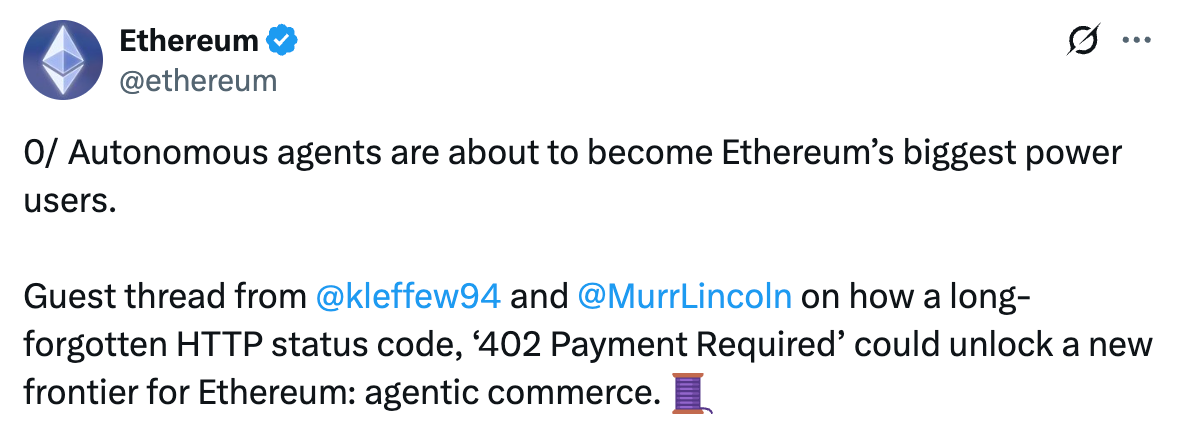
All of this would appear to stem from an idea that a couple of developers at Coinbase had, which they published a Twitter thread about back in August: |
The idea, put very simply, is that AI agents will soon be transacting with each other (on behalf of consumers and businesses) autonomously and continuously, and, to do that, consumers and businesses will need new protocols, frameworks, and (perhaps?!?) forms of payment.
This is why Coinbase is building the x402 protocol, which cleverly takes advantage of an antiquated and unused HTTP status code to facilitate agent-to-agent transactions without the need for accounts, subscriptions, or API keys.
Now, to be clear, neither Coinbase nor Google is arguing that such transactions should only be conducted in stablecoins. Google’s design partners in this agentic commerce initiative include American Express and PayPal. And the description of x402 sounds similarly agonistic when it comes to the payments part: Future iterations of x402 are expected to support a range of payment methods, including credit cards, bank accounts, and stablecoins. Cloudflare is proposing a new deferred payment scheme for x402, which allows for delayed settlement and aggregated charges — ideal for scenarios such as batch processing or subscriptions. In fact, that last sentence about creating a deferred payment scheme for batch processing sounds positively TradFi.
And yet, we know Coinbase’s interest is in putting crypto at the center of x402. And Clouflare is reportedly working on its own stablecoin. So, how will all of this play out? I don’t know, but here are a few questions I am thinking about: -
Why are stablecoins preferable to other electronic payment systems for agentic commerce use cases? It would seem as though the programmability benefit of stablecoins (which has always felt very abstract to me) would be rendered irrelevant if we have intelligent AI agents orchestrating the transaction on either side. Perhaps the appeal of stablecoins for a company like Cloudflare is in their native global interoperability (Cloudflare’s network covers cities across 120 countries)?
-
Related to that point, all things being equal, why exactly would a buyer choose to use stablecoins? Credit cards are going to be compatible with agentic commerce (Visa and Mastercard are doing everything in their considerable power to ensure this) and consumers (and businesses) like buying stuff with credit cards. In some commerce transactions, the seller has enough leverage to force the buyer to use their preferred payment method (which may or may not be stablecoins). However, in many instances, the buyer has more leverage. How will stablecoins compete to be the payment method of choice for buyers in an agentic commerce future? If your answer is rewards, please be prepared to explain how that won’t lead to a ruinous race to the bottom for stablecoin issuers.
- Wouldn’t Coinbase prefer that Cloudflare use USDC (which is functionally the native currency of Coinbase) rather than develop its own stablecoin? Especially since Circle is also developing its own L1 blockchain, specifically focused on payments use cases? How hard did Coinbase try to convince Cloudflare to just go with USDC?
-
Will Cloudflare succeed in forcing AI companies to pay for their training data? And if so, why wouldn’t the AI companies insist on paying with their own stablecoins (which are surely coming) rather than the one issued by Cloudflare?
-
It feels weird not to have seen Stripe’s name anywhere in any of these stories. What is Stripe planning to do at the intersection of stablecoins and agentic commerce?
|
(Editor's Note — After I wrote today's newsletter, Stripe announced that it is going to power instant checkout for commerce transactions inside ChatGPT, a new agentic commerce protocol [co-developed with OpenAI], and a new API for agentic payments. Curiously, Stripe did not jam the word “stablecoin” anywhere into any of these announcements. I admire its restraint.)
|
FIS is acquiring Amount: Payments processor Fidelity National Information Services has acquired Amount, a fintech that provides deposit and loan origination software, according to a Wednesday news release. Chicago-based Amount provides consumer and small business deposit and loan origination software. FIS said Amount will expand the services it can offer bank and credit union clients, and aligns with its strategy to add cloud-native and “modular” products and services. Terms of the deal weren’t disclosed, and an FIS spokesperson declined to comment. Amount has 158 employees, all of which have joined FIS, the spokesperson said. FIS will maintain the fintech’s Chicago location. |
Amount was spun out from the online lender Avant in 2020 and raised about $140 million from QED and Goldman Sachs. It then raised another $100 million (co-led by WestCap and Hanaco) in 2021, which valued the company at $1 billion.
Then, as was the case for many late-stage fintech companies at that time, the trouble started.
In 2022, Amount acquired Linear, a loan origination platform for small business lending, for $175 million. This was mildly concerning at the time because Amount still hadn’t seen much traction in its core business (loan origination for unsecured personal lending and BNPL), which became clear when the company laid off 18% workforce shortly after, and another 25% less than a year after that. In desperation mode, Amount turned to the same place many struggling fintech infrastructure companies turn: credit unions. It received an unspecified investment from PSCU (the largest credit union servicing organization in the U.S.) in 2022. This was followed by a $30 million funding round in 2024, led by Curql Collective, a VC investment firm funded by credit unions. From what I can tell, none of this strategic flailing ended up working. Amount never meaningfully grew its core personal lending/BNPL business. The Linear acquisition never produced “1+1=3” results. And the pivot to credit unions doesn’t appear to have gotten much traction.
And yet, FIS is buying them. Because of course they are. If assimilating acquiring you can, even in the tiniest degree, help FIS sell stock market analysts on its long-running “cloud-native, AI-centric digital transformation” story, you will be assimilated acquired.
|
|
|
Hear how top fintech risk & compliance leaders are future-proofing FinCrime Ops tomorrow! Featuring Elliot Rosenthal (Trustly), Trisha Kothari (Unit21), and Ethan Singleton (FS Vector). Register here. |
|
|
It’s officially Money20/20 season, which means I’ll be highlighting a handful of (rotating) sessions, meetups, and happenings in every newsletter.
Some I’ll be at, some just look too good to miss. You’re welcome!
🏀 Fintech Takes The Court @ Money20/20 | 10/26 | 10am–2pm PT
Sunday morning: we’re playing basketball, baby!
Join us for a high-energy 3x3 pickup game, hosted by Fintech Takes & SOLO. All are invited - female, male, young, old, seasoned, out of shape. Bring your A-game (or just your sneakers) and come play or hang courtside with fellow fintech enthusiasts. RSVP here. 💰 Deepfakes, Real Risk: Fighting Fraud in an Age of Synthetic Identity | 10/26 | 3:00pm–3:30pm PT I’m thrilled to be moderating this discussion at Money20/20, featuring the head of fraud at Varo and the co-founders and CEOs of SentiLink and Oscilar.
☕ Nova Credit Coffee + Conversation | 10/27 | 8:15am–10:30am PT
Start the AM with lending leaders unpacking the real-world journey of cash flow analytics (where to begin, how to apply it, and what it takes to make it work). Breakfast, networking, and discussion included! RSVP here. 🍸 MX Happy Hour Panel: Data into Action | 10/27 | 3:30pm–6pm PT
Small panel conversation featuring Jane Barratt (Chief Advocacy Offer, MX) and yours truly (among others!): 3:30pm–4pm panel, followed by drinks and hors d’oeuvres at The Grand Lux Cafe, Venetian (5-6). RSVP here. 🍸 Fundbox After Hours | 10/27 | 7:30pm–9:30pm PT
Come for the conversation on the future of embedded finance and small business lending. Stay for the one-on-one conversations (over drinks and appetizers, of course!) |
|
|
2 READING RECOMMENDATIONS |
Simon is far more emeshed in the AI/stablecoin world than I am, so he’s a good resource to lean on as activity in this area picks up. |
The gods of the Substack algorithm suggested this essay (and newsletter) to me and I’m glad they did! Tomas has an intriguing way of explaining the world using geography, which, as a former social studies teacher, I appreciate. |
There are a TON of interesting questions being asked in the Fintech Takes Network. I’ll share one question, sourced from the Network, each week. However, if you’d like to join the conversation, please apply to join the Fintech Takes Network. How many stablecoins will we end up with?
The number that the market can bear has to be less than infinity, which (going by the press releases I’ve seen) seems to be the current plan. How many can it bear? And which ones will win?
If you have any thoughts on this question, reply to this email or DM me in the Fintech Takes Network! |
|
|
FINTECH TAKES: BUILDERS SUMMIT |
As you may know, Fintech Takes is hosting our first-ever in-person event on November 12th and 13th in the mountains outside Bozeman, Montana.
The Fintech Takes: Builders Summit is the industry event that I’ve always wanted, but have never quite been able to find. We are bringing together experienced founders and operators from banking and fintech — the folks who are actually building products in our industry — and giving them the content and networking opportunities they need to find (and understand) the next big problem they are going to tackle.
If that sounds like something you’d be interested in participating in, apply to attend or hit reply to this email to get more information on sponsorship opportunities. We still have room, but it is going fast! |
|
|
Thanks for the read! Let me know what you thought by replying back to this email.
— Alex |
|
|
{if profile.vars.rh_reflink_11}  | Share with Fintech Takes, get cool stuff! | Have friends who'd love Fintech Takes too? Click the link below to share with your friends and get awesome rewards when they subscribe! | |
|
PS: You have referred {{profile.vars.rh_totref_11}} people so far | | Share Fintech Takes! | |
|
{/if} |
|
|
Get your brand in front of 55,000+ fintech and banking executives. |
Workweek Media Inc.
1023 Springdale Road, STE 9E
Austin, TX 78721
Want to ruin my day? Unsubscribe. |
|
|
|