Nvidia *Intends* To Invest $100B Into OpenAI
There’s that incredible scene in the mockumentary This Is Spinal Tap when the guitarist shows off his amplifier by turning the volume knob “up to 11” (because the dial at 10 isn’t loud enough).
As it relates to AI hype cycle, some of you may have foolishly believed that Softbank’s $40B investment in OpenAI earlier this year was an 11 on the dial. Nope.
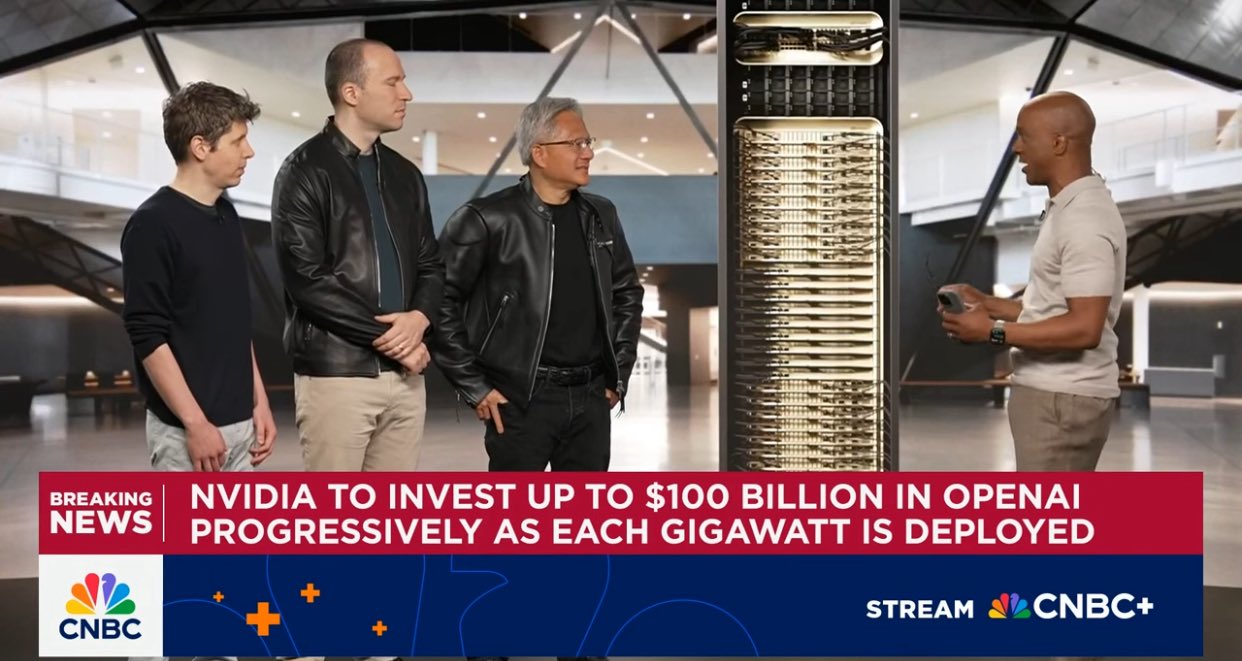
That was closer to a 7 or an 8. The knob only officially hit 11 last week with the announcement that Nvidia “intends to invest up to $100 billion into OpenAI”.
Now, the words “intends” and “up to” are major qualifiers but do make sense because:
This financing structure is meant to prevent dilution of existing investors, per CNBC:
The initial $10 billion tranche is locked in at a $500 billion valuation and expected to close within a month or so once the transaction has been finalized, people familiar with the matter said. Nine successive $10 billion rounds are planned, each to be priced at the company’s then-current valuation as new capacity comes online, they said.
If Nvidia closed the full $100B right now, that would be 20% of OpenAI’s current valuation.
A guy I know that owns 1% of an SPV of an SPV of an SPV that owns 0.1% of OpenAI would not be happy with such rapid dilution. However, Nvidia investing over time is more palatable for the existing OpenAI cap table and matches up well with the chipmaker’s sales cycle (the $4.5T firm currently has ~$50B cash and is generating free cash flow of $15-20B each quarter).
Let’s assume OpenAI builds out the 10GW over the next decade. Each successive $10B investment by Nvidia will receive a smaller slice of ownership as long as OpenAI’s valuation goes up (the first $10B will be for 2% of the equity).
M.G. Siegler did some napkin math and thinks OpenAI in the early 2030s could be “nearly [33%] owned by Microsoft, with SoftBank and NVIDIA taking up another roughly 25% combined” or about 12% each.
OpenAI’s non-profit arm is looking at a 20% stake, which would leave 22% for everyone else (including Sam and potentially even Elon based on how his various lawsuits shake out, since he was the first money into OpenAI in 2016).
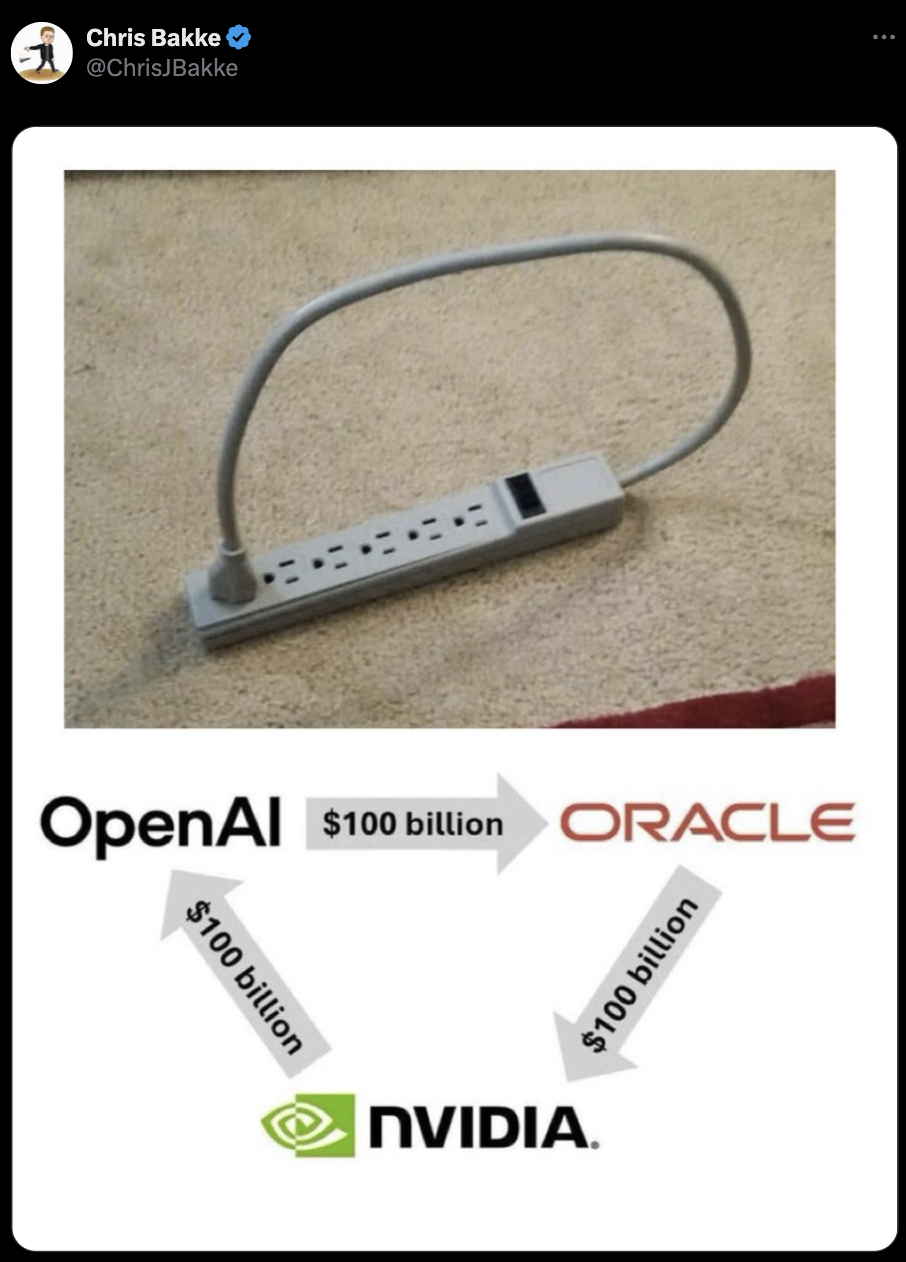
The popular reaction to the deal was captured in this post by Sully Omarr:
so let me get this right:
Oracle says Openai committed $300B for cloud compute → oracle stock jumps 36% (best day since 1992)
Oracle runs on Nvidia GPUs → has to buy billions in chips from Nvidia
Nvidia just announced they’re investing $100B into openai
Openai uses that money to... pay oracle... who pays Nvidia... who invests in Openai
So much circular and definitely feels bubbly. It’s worth noting that many of the Big Tech players have been paying for their GPUs with free cash flow but have had to tap debt markets as their capex spend goes through the roof.
Debt means that the AI race is entering a new (and riskier) chapter.
I get the rationale for this $100B Nvidia-OpenAI partnership, though.
Nvidia is printing so much cash that it needs to find ways to deploy it. They recently announced a $60B share buyback. That’s one way. Tossing $5B into Intel soaks up some cash. $900m to acquihire the CEO of AI hardware startup Enfabrica soaks up a bit less. This OpenAI deal — which helps to ensure the largest AI consumer platform in the world (700m+ users) has access to compute — is soaks up a lot more. On top of that, it owns 7% of $60B AI cloud provider CoreWeave and has invested in Elon’s xAI.
On a recent episode of the BG2 podcast, Jensen said he views the potential $100B outlay as more of an investment because he believes OpenAI will be the next “multi-trillion dollar hyperscaler” to compete with Microsoft Azure, Amazon Web Services and Google Cloud. Nvidia is already an “AI infrastructure partner” with those other cloud giants as well as helping to build xAI’s massive data centres.
Meanwhile, OpenAI needs to access as many pots of money as possible. It’s contracted $300B with Oracle (who will happily take the business) but currently only has $13B in revenue (although its inevitable ads business will help boost that number).
Will the AI hype cycle continue? A major point that Jensen’s been making is that the market size for inference will be 1,000,000,000x larger than the original ChatGPT because of the reasoning tokens. That forecast is also an “11” on the dial but is consistent with the industry’s attempts to make “agentic AI” happen (on a very related note: OpenAI released a product called “Pulse” that is like a personal assistant who combs through all your chats and comes up with ideas or questions to advance your goals while you sleep and drops you a summary in the morning).
How you feel about that statement probably correlates well with how you feel about the overall bubbly-ness (this also applies to your feelings about Sam Altman’s related blog post “Abundant Intelligence”, where he says he wants to eventually deploy 1GW a week because he doesn’t want the world to have to choose between “how to cure cancer” or providing “customized tutoring to every student on earth”).
Either way, the biggest loser in the deal was investment bankers, who look to make 0.0000% from the potential $100B partnership:
Altman and Huang negotiated their pact largely through a mix of virtual discussions and one-on-one meetings in London, San Francisco, and Washington, D.C., with no bankers involved, according to people close to the talks who declined to be named because they weren’t authorized to speak publicly on the matter.
Just old-school negotiating right there. A “mix of virtual discussions” and “one-on-one meetings” could also describe that time I messaged MJFan76891 on Craigslist and met him at the Starbucks three blocks from the subway station to buy a pair of used Air Jordan 11s (Space Jam Edition)….except my deal was 3-figures while theirs was 12-figures.
Until the 10GW is fully deployed, the biggest winner so far is the leather jacket industry: