{if ftt_dorm_120 == true}
Quick favor: Our records indicate that you aren’t opening this email. But records can be wrong. Please click here if you’d like to remain subscribed to Fintech Takes. |
|
|
{/if}{if membership_newsletter_optin == 'true'}
It looks like you’re a Fintech Takes Network member but haven’t been receiving the newsletter. We’ve added you to make sure you get the full experience (and if you’d rather not get it, you can always update your preferences at the bottom of this email). |
| |
{/if}
Was this email forwarded to you? |
|
|
3 BIG IDEAS FROM THE PODCAST |
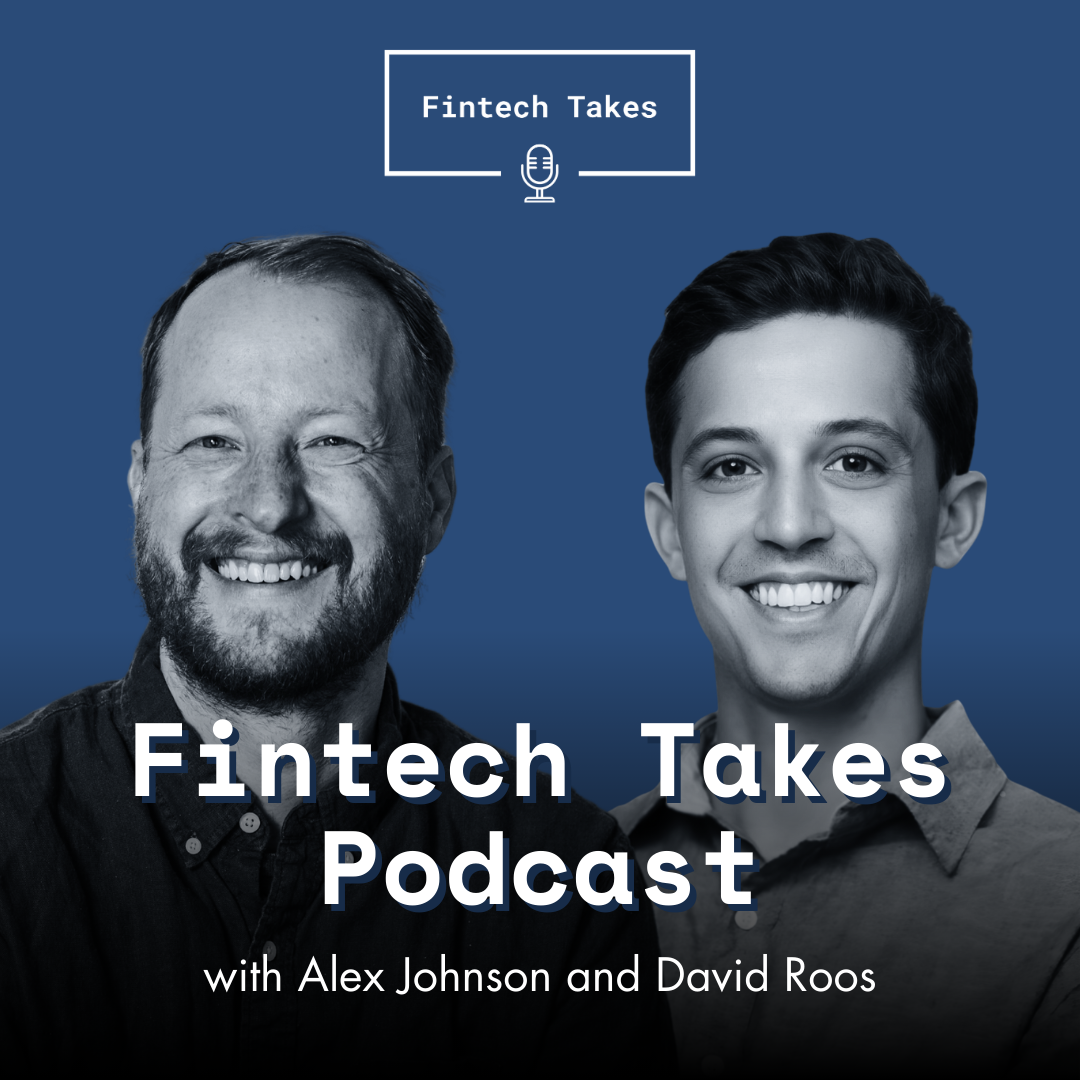
Bad investors talk about rocket ships. Good investors are more interested in whether the screws actually fit. That gap (Reality vs. Twitter) serves as the spine for my conversation with David Roos, Partner at Core Innovation Capital.
We dig into what sets great founders apart (mercenary grit plus missionary obsession), how venture has fractured into two camps (giant funds indiscriminately putting down bets, and specialist firms that actually pick up the phone when a founder calls), and why going public now is such a big leap. Plus, some nuance on JPMC’s attempt to meter access to customer data (recorded before the Plaid news broke) and how AI enables ten-person teams to punch like a hundred (with the right guardrails) … |
And read below for my three big ideas... |
#1: Precarity Is the Market |
This may seem counterintuitive, but in fintech, being “mission-driven” is the best way to build something that scales profitably.
As David put it, 90% of Americans encounter some form of financial insecurity.
That makes precarity the mass market, not a niche. The opportunities to serve that market are in building infrastructure that helps lower costs and create more chances to build wealth: housing, healthcare, and small-scale entrepreneurship.
Core Innovation Capital looks for founders who are mercenary enough to raise the capital, missionary enough to attract talent, obsessed enough to run headfirst into operational walls, and self-aware enough to know they can’t solve it alone.
Because in a nation where 9 out of 10 households live with some form of fragility, scale in financial services doesn’t mean chasing niches — it means solving for precarity at a mass-market level. |
|
|
#2: Option Money Isn’t Conviction Money |
Big checks from mega-funds look and feel like validation, but in fintech, they’re usually just option bets that mess with your signals. David painted today’s venture market as bifurcated. On one end, you’ve got the mega-funds (multi-billion-dollar funds sucking up a lot of the capital in the industry). On the other end, you’ve got small, sector-specific funds playing early and deep in the weeds. The middle? Practically extinct (and not unlike every other industry right now. It’s why your only movie choices on a Friday night are a global blockbuster about superheroes or a teeny Sundance indie engineered to break out precisely because it’s an indie). So, when a $2B fund writes you a $5M seed check, it’s not conviction: it’s an option bet. What they’re really saying is: if you work out, we’ll put in a big check later. There are problems with this. Among them are: - If they don’t follow on, it’s a scarlet letter. Other investors assume something’s wrong.
-
You don’t get their time. A portfolio full of option bets means no hands-on help.
- It warps your feedback loop. Instead of listening to customers, you start chasing the expectations of a brand-name logo that was never committed in the first place.
This distortion is especially brutal in financial services, one of the most operationally and regulatory complex environments you can build in!
That’s why repeat founders often play it differently. First-timers chase the shiny logo; second-timers raise smaller and later, partnering with funds whose incentives align more tightly (and who’ll stay on the line long after the fundraising shine fades).
Capital is never neutral. It’s a signal that can help shape or sink your trajectory. |
#3: AI and Startups: State of the Nation |
And now, just as capital has gotten harder to read, AI shows up in the mix (raising more questions than answers).
On the one hand, it’s making small teams feel like big ones. David told the story of a company they invested in that had spent $1M to reach a $4M revenue run-rate with a team of fewer than 10.
In 2021, a Series A meant showing $1M ARR. Today, the bar is closer to $3M … because investors expect AI to stretch your dollar that far.
But scaling in fintech isn’t just about doing more with fewer people. It’s about doing it in a highly complex, regulated environment where “move fast and break things” has always been a non-starter.
That’s why, in financial services, AI can’t be just a tool – it needs to come with context (embedded in workflows), coordination (humans in the loop), and trust (guardrails when handling people’s money).
Which brings us to the big questions. If anyone can plug into the same data, is context the only real edge left? If trust is the critical element, do startups have the advantage or do entrenched incumbents?
And what happens when AI can scale faster than the guardrails we’ve built to keep money safe? |
|
|
This episode of Plain English RULES. I’ve never heard a better discussion on the business and financial realities of the current AI buildout. Exceptional stuff. |
Three of my favorites — Jason Henrichs, Brett King, and the incomparable Jennifer Tescher — talking about one of my favorite topics. Enough said. |
Last chance to hear how top fintech risk & compliance leaders are future-proofing FinCrime Ops!
Elliot Rosenthal (Trustly), Trisha Kothari (Unit21), and Ethan Singleton (FS Vector) will unpack what makes detection systems hold up (or fail), when AI is ROI vs. vaporware, and how to keep risk, compliance, and product aligned without slowing growth. Seats are limited; register here.
|
Year 2 for this one as well. The first one was a lot of fun (plus, I’m digging all these conferences in my backyard … Silicon Slopes for the win!) |
|
|
Thanks for the read! Let me know what you thought by replying back to this email. — Alex |
|
|
{if profile.vars.rh_reflink_11}  | Share with Fintech Takes, get cool stuff! | Have friends who'd love Fintech Takes too? Click the link below to share with your friends and get awesome rewards when they subscribe! | |
|
PS: You have referred {{profile.vars.rh_totref_11}} people so far | | Share Fintech Takes! | |
|
{/if} |
|
|
Get your brand in front of 56,000+ fintech and banking executives. |
Workweek Media Inc.
1023 Springdale Road, STE 9E
Austin, TX 78721
Want to ruin my day? Unsubscribe. |
|
|
|