The Day Quentin Tarantino Became A Filmmaker
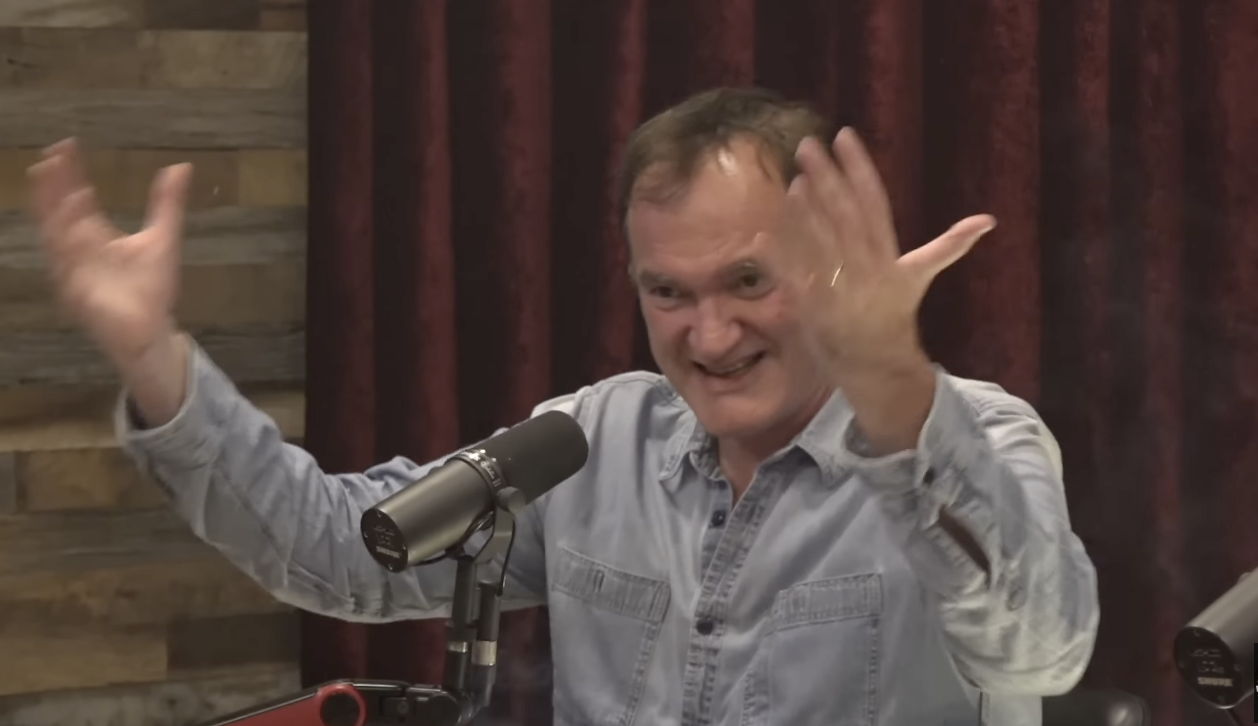
There is a podcast called The Church of Tarantino Podcast.
It’s a weekly show dissecting Tarantino films from every possible angle imaginable. Turns out Tarantino actually listens to the podcast and, in August, they hosted him for one of the most meta podcast episodes ever (this would be like Huy Fong’s David Tran showing up to my monthly Sriracha hot sauce making competition…which, David, the invitation is very open…please reply to this email).
Tarantino has some great insights about his 30+ year career. I’ll share the best excerpts below, but first want to flag my favourite piece of career-related Tarantino lore.
At the end of 2024, the 62-year-old director told Joe Rogan about the exact day he decided to pursue a film career.
Tarantino is such a great storyteller that he riffed for ~10 minutes building up to the exact moment he made the decision.
In his early-20s, Tarantino was working as a video store clerk for Video Archives in Manhattan Beach, California.
He was always interested in making films but tells Rogan that the job took the fire and ambition away from him:
I was thinking of making my own stuff for a long, long time.[However], I did fall asleep for a few years. Working at the video store, I got caught up in the little life there. […]
It’s one of those things where [the video store job] isn’t my dream. I didn’t want to work at a video store for years. I wanted to make movies.
But it’s dream-adjacent. It’s close to my dream. I get to watch movies all f**king day. I get to talk about movies all f**king day.
I’m not working at a pizza parlour. I’m not busting ass as a bartender…I’d go to this video store if I wasn’t paid to go to this store. But for a couple of years, [the video store job] put me to sleep. It put my ambition to sleep a little bit because I was happy enough.
But there was a “life-changing day” when he “got the fire back again”.
So, Tarantino had a roommate that was five years older named Steve-O. The day Steve-O turned 30, Tarantino remembers that his friend's personality changed. Steve-O was always a funny guy but became angrier and more bitter. He had spent his 20s hanging out with people Tarantino’s age and not accomplishing any of his professional goals.
“I wasted my life hanging out with a bunch of guys just like you,” Steve-O told Tarantino in one rant.
Soon, Steve-O started hanging out with more people closer to his own age.
Tarantino said that Steve-O’s personality change was “showing me a truth”.
That truth was that Tarantino didn’t want to be a bitter 30-year old.
When Tarantino turned 25, he had “anxiety…seeing what it’s like five years from now when you turn 30” and decided to take stock of his life:
There was one night when I did [something I called] a “Quentin Detest Fest”.
I’d stay up all night long and — rather than giving myself excuses — I'd spend all night laying out what I was doing wrong [with my life] and spending two hours on how I would change it.
Instead of falling back into my routine, I decided to change my life. I [decided] to move to Hollywood and meet other people in the business. I shouldn’t be making money until I’m making money what I want I to do.
Indeed, Tarantino packed up and moved to Hollywood. Well, the closest he could afford, which was in Koreatown.
He started meeting people making low-budget horror movies and began building a network in the film industry.
“If these guys can do it,” Quentin realized. “I can do it. Within a year and a half, I was finally able to make a living as a writer.”
At 27, he sold the script for True Romance for $50k. In 1992 — when he was 29 — that film hit theatres, directed by Tony Scott and starring Christian Slater. That same year, Tarantino made his directorial debut with Reservoir Dogs.
Two years later, he released his second film Pulp Fiction, starring Samuel L. Jackson and John Travolta.
Then, Tarantino turned 32 on March 27, 1995. This was the same day as the Academy Awards…and he won a Best Original Screenplay Oscar for Pulp Fiction (along with Roger Avery).
Tarantino has now done 9 feature films (he counts Kill Bill series as one): Reservoir Dogs (1992), Pulp Fiction (1994), Jackie Brown (1997), Kill Bill: Volume 1 (2003), Kill Bill: Volume 2 (2004), Death Proof (2007), Inglourious Basterds (2009), Django Unchained (2012), The Hateful Eight (2015) and Once Upon a Time in Hollywood (2019).
He plans to finish one more and leave a 10-film body of work, which will certainly rank among the greatest ever.
Look, I know there are probably thousands of other people that made Tarantino’s same realization and went to Hollywood and never realized their dreams.
Having said that, Tarantino's story is pretty damn relatable story. Lulling yourself into complacency while having fun with the homies and doing “dream-adjacent” things but putting your real ambition “to sleep” because you’re “happy enough”.
People do that in their 20s, 30s, 40s and beyond.
Tarantino made a drastic change and we should all be incredibly happy it worked because the Mr. Wolf scene in Pulp Fiction is some of the greatest dialogue in the history of the written word.
***
Highlights From the Church of Tarantino Interview
-
The 3 Best of His Own Films: “Well, I guess Inglourious Basterds is the best film I made. Once Upon a Time in Hollywood is my favorite. But I think Kill Bill is the ultimate Quentin movie. Like nobody else could have made it. Every aspect about it is so particularly ripped — like with tentacles and bloody tissue — from my imagination and my id and my loves and my passions and my obsession. So, I think Kill Bill is the movie I was born to make. I think Inglourious Basterds is my masterpiece, but Once Upon A Time In Hollywood is my favorite.”
-
The Sacrifices He Made Early In Career: “I'm the guy who did not let life get in my way artistically. That was my life for the last 30 years. And I wasn't looking to get married and I wasn't looking to have children [Tarantino got married in 2018 and now has two kids]. I wasn't looking to have anything that was more important than the journey. And there was nothing more important than the journey. The journey always came first. The mountain. I always made it a mountain-climbing analogy. So, Kilimanjaro and Mount Fuji and Everest, they were always the most important things. I've done my time. That doesn't mean I'm an old man now and that everything is lesser. But like I said, I've done it and I'm just enjoying this time.”
-
The Excitement Of Doing Something New (Which Is Why Tarantino Decided Not To Direct The Spin-Off or Sequel to Once Upon A Time In Hollywood): “I got into pre-production [for a Once Upon A Time In Hollywood spin-off]. It was the same f**king thing…I love this script, but I'm still walking down the same ground that I've already walked, and…there was no question that the ship would arrive at port. There was no question that we won't sink. There's no ceiling for me to hit the head of my talent on. And it just kind of un-enthused me as we went forward.
So, I finally just pulled the plug. [The 10th and last film I do], I've got to be in uncharted territory and have an idea how I'm going to pull it off, but not really know. There has to be something to achieve.”
-
On The Value of Creating Scarcity (After He Got Back Full IP Rights for Kill Bill): “I love my old work, but I'm not all that about mining it and taking from it and spinning off from it…In this world, that everything is available and everything is for profit and everything is a chip to be sold on the market because everything is owned by corporations.
[Kill Bill is] not owned by a corporation. That's owned by me. The fact that you have to come to my theater [where he occasionally screens the film] to see it, and it's not just sitting on a stack of DVDs and Blu-Rays that you get around to watching eventually…The minute it becomes in your hand, it just means less.
All right, but the thing is the fact that it's playing at a theater. Now you guys came to see it and you got it in just the best way. And no, you can't lend it to your friend. Now you're going to have to tell your friends about it and they're going to be jealous of you. That just happens so f**king rarely now that there's something really, really cool about having something that's just not a button away.”
-
The Legacy He Wants People In 50 Years To Think Of Him: “[Using] your 50-year analogy, I hope that I have the same impact that Hitchcock has today. [People will see] I did my things in my time and I did them well and I create a certain thing that you get from my stuff and then other people took it and did their own things with it. But if you want the real deal, you go to me. And each generation picked it up and made it their own.”
Go listen to the interview.