Hello! Welcome to Fintech Takes Banking, my weekly newsletter where I highlight things that are interesting or important for bankers and the surrounding environs.
I spent some of last week in the Park City area, where I am annoyingly still a little sensitive to altitude but thought a lot about what’s possible when financial institutions use data effectively. Learning nothing from that experience, I spent the weekend in Denver, where some of my friends and I attended the Normal Gossip live show! 🎧 Go see podcast recordings with your friends!
|
Was this email forwarded to you? |
|
|
Acting on Data to Turn Data into Action
|
It is distinctly not new, innovative or interesting anymore to say financial institutions need to use their customer data better. And yet it is 2025, and here we are: financial institutions need to use customer data better. They need to see it as a signal to react, and eventually, an anticipatory act. And many have a long way to go!
Those are my observations from MX’s 2025 Money Experience Summit, coupled with the release of Bank Director’s 2025 Technology Survey. The survey came out the day I traveled to the conference, creating an interesting association for me between the technology initiatives at community banks and broader developments and trends in data access and open banking.
What do the findings of 100-plus directors and senior executives at midsized and community U.S. banks have to do with a conference put on by a data aggregator that works with financial institutions? A lot! Survey Says… |
Data is a big theme of the technology survey. Respondents do not think their institutions are good at data, they do not think they have a lot of their customers’ data and they believe data limitations may hold back their institutions down the road. But in my read, it was also not a big priority relative to other tech initiatives. - More than 50% of respondents said their bank did not use data effectively in operations, marketing, enterprise risk management or human resources — or they weren’t sure if they used data effectively.
-
Forty-six percent of respondents said data strategy and management were the areas of their institution that most critically needed additional in-house expertise.
-
Less than 10% of respondents believe their bank has 75% to 95% of their customers’ data. That compares to half of respondents who think their institution has access to half of their customers’ data or less. If only there was a permissioned data sharing standard that they could leverage, perhaps passed by a consumer financial protection agency or bureau!
-
About a third said the challenge they were most concerned about when it came to their bank’s use of technology is the inability to use data efficiently.
-
Another complicating factor in banks’ data initiatives could be the accessibility and usability of the data. Fifty-six percent of respondents said their institution keeps data in the system or platform that generated it, and another 56% said they rely on their core to access it (respondents were allowed to select all options that applied).
-
But despite these concerns, only 28% of respondents said their bank upgraded or implemented data analysis platforms and capabilities over the past 18 months.
-
It also seemed like leadership was paying attention to other technology imperatives in a way that I feel is almost contradictory. Only 13% of respondents said their bank’s leadership team and/or board discussed allocating budget or resources to open banking in the past 18 months, compared to 66% that discussed artificial intelligence.
Open banking and artificial intelligence both share a fundamental ingredient: data, particularly data in a usable state. (Before you come at me with “Yeah, but generative AI doesn’t need structured data,” 52% of respondents to a different question said their institution was not using generative AI in any business area.) Tell me how far you think your bank can get with AI tools and applications without effective data management and analytics!
The overall takeaway is a little frustrating and demoralizing. I don’t believe it’s radical at all to think that the direction of consumer preferences, coupled with the market practice of open banking technology, means that the ability to analyze and leverage data will be more important to institutions in the future than it is in the present. And it’s pretty important and urgent now. |
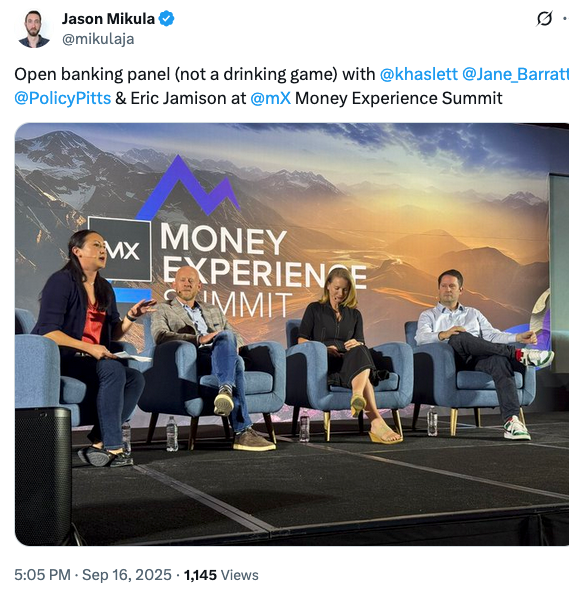
If a community financial institution wants to use data to be more efficient or serve customers better, there are a number of data aggregation companies it can work with. One of those is MX, which was kind enough to ask me to moderate a panel of data aggregators at their Money Experience Summit. We discuss the state of open banking today — including Section 1033’s current legal battle and the very interesting news that Plaid had agreed to a pricing sheet with JPMorgan Chase & Co. — as well as the future. Very little recap of the panel here, because you just had to be there. 😉
Thus, I moved out of a reality where banks say they’re struggling to use their data to one where that’s the biggest focus. (Can’t tell you how awesome it was to go three days where I didn’t have to hear much about stablecoins and cryptocurrency much at all.) |
Thanks to Jason for being such a good panel friend and sitting in the front row, where he took this photo! To my right are Eric Jamison, head of product at Yodlee; Jane Barratt, chief advocacy officer and head of public policy at MX; and John Pitts, head of industry relations and digital trust at Plaid. |
Data is a “strategic imperative” for financial institutions seeking to better serve their communities, said Rodney Hood, who recently wrapped up a stint serving as acting comptroller of the currency and who has chaired the National Credit Union Administration. He said institutions need to approach data not just as a metric, but as the way to build a narrative of their customers’ lives so they can meet and anticipate their needs. They’re the words that will fill out the story, if you will.
Hood said successful partnerships he’s seen look like data dashboards enabled by APIs that increase the confidence of financial institution executives and their customers, alternative credit modeling that uses rental and utility payment data to responsibly extend credit to credit-invisible individuals and personalized, real-time financial guidance that can help customers manage both emergencies and their long-term goals. To do that well, financial institutions need to ensure they’re well capitalized, prioritize customer financial health and work with data partners like MX.
That combination had some resonance at Tukwila, Washington-based BECU, said Jason Rudman, the chief member and digital experience officer. He said the $29 billion credit union is shifting from a “product-led experience to a journey-led experience,” to move members through financial access and financial health to financial freedom and ultimately financial prosperity. To that end, the credit union recently acquired the AI advisor technology assets of EarnUp and is rolling out a generative AI financial advisor tool that offers personalized advice and helps members take action.
A later panel that day (moderated by my friend and colleague Alex Johnson) highlighted one such journey that financial institutions could build for customers and members: retirement. Alex’s panel discussed how different generations think about finances and included a panelist who recently retired and a panelist who is a decade from retirement.
I’m in my 30s; for me, “preparing for retirement” means diligently socking away a percentage of my paycheck into my employer-managed retirement funds and… not much else! So I was stunned to learn from their experiences that there seems to be both too much and not enough information about how to prepare one’s finances and health insurance for retirement, and no information seemed to be coming from these individuals’ financial institutions. Do their banks not know their customers’ ages? Do they not realize they’ve stopped receiving a paycheck? Do they think inviting a 50-year-old customer to chat with a financial advisor about prepping for retirement would be unwelcome? What, exactly, do banks see their role as here as Gen X prepares to retire? It seems like in 2025, some financial institutions subscribe to a “caveat emptor” approach; maybe they’ll change their tune by the time I need this advice. (Or maybe my AI agent will manage all this for me and interact with my bank’s AI agent.)
Hood said federal financial regulators are aligned on digital innovation and have collaborated on supervisory frameworks. He seemed optimistic that regulators would help institutions as they look to increase financial inclusion, community investment and economic development, but added that executives need to make sure their examiners and regulators are part of their journeys to avoid surprises. I mean, sure! We love to hear it.
But my concern now isn’t that regulators will hinder banks’ attempts to use data; it’s that small and midsized banks won’t do this work if they’re not forced to. It’s entirely possible that none of the conflicts in Section 1033 will be meaningfully and credibly resolved in this next round of rulemaking. It’s possible that after a reissued standard, there’s another lawsuit that further postpones effective dates for institutions. It’s possible that without open banking regulations, a swath of U.S. banks and credit unions decide they don’t need to do more to facilitate open banking for themselves and their customers.
Is the lack of progress and investment in data that banks reported in the technology survey evidence of this? In a world where the future is almost guaranteed to have greater demands and use for data compared to today, that feels like a dangerous decision to make.
|
|
|
What I’ve been reading, watching and listening to this week: |
😱 Haunted by: “the flippening,” which I learned from this 8ball newsletter is not a science fiction phrase for a time loop, but is a demographic term coined by event analyst Marko Jukic where “the old will soon outnumber the young” because the U.S. population is shrinking. Great! |
🤔 Thinking about: SouthState’s Chris Nichols’ analysis of stablecoin business models for banks and his conclusion that institutions as small as $400 million in assets can benefit. “The margins are sufficiently large to make this line of business attractive for most banks,” he wrote. |
💸 Digging out: my old Pokémon cards to sell since they’ve seen “a roughly 3,821% monthly cumulative return since 2004, according to an index by analytics firm Card Ladder tracking trading-card values through August,” according to The Wall Street Journal. |
Thanks for reading! And my personal thanks to Bank Director’s Technology Survey, one of my favorite pieces of research to reference, and to MX for the opportunity to moderate such a lively panel on data aggregation. Let me know your thoughts on this piece. – Kiah |
|
|
Get your brand in front of 55,000+ financial services execs. |
Workweek Media Inc.
1023 Springdale Road, STE 9E
Austin, TX 78721
Want to ruin my day? Unsubscribe. |
|
|
|