{if ftt_dorm_120 == true}
Quick favor: Our records indicate that you aren’t opening this email. But records can be wrong. Please click here if you’d like to remain subscribed to Fintech Takes. |
|
|
{/if}Happy Wednesday, Fintech Listeners!
Kiah Haslett — author of the brand new Fintech Takes Banking newsletter — published her first piece yesterday and, unsurprisingly, it’s excellent.
Read it here and then go subscribe, if you haven’t already! — Alex |
Was this email forwarded to you? |
|
|
3 BIG IDEAS FROM THE PODCAST |
This week on the Fintech Recap with Jason Mikula, we covered a lot of familiar ground.
Open banking (again). BaaS Island and Synapse (again). Stablecoins (Kurt Russell voice: AGAIN!)
The trend is becoming clear: financial services is continuing to lose its guardrails as the industry leans into speed and improvisation — one lawsuit, one bailout, one token at a time. |
And read below for my three big ideas... |
#1: Calvinball: Lawsuits Without End |
Thanks to Loper Bright, the Chevron doctrine is gone. Corner Post erased the statute of limitations for challenging federal regulations. Put those together and you get the regulatory equivalent of Calvinball (the Calvin and Hobbes game where the rules change constantly and never stick). The CFPB’s new 1033 rule is already caught up in this spiral. Whether it defines access by “agent or trustee” or the vaguer “representative,” whatever it writes will be sued into oblivion.
Another relevant example is Visa. After years of investing heavily in open banking (buying Tink and then expanding to the U.S.), it abruptly shuttered its U.S. unit. The official line explaining this move was “regulatory uncertainty,” which I was initially skeptical about (Visa’s biggest customer is JPMorgan Chase, which seems like a much more logical reason for the abrupt change). However, maybe Visa is right. Maybe its decision isn’t so much about the current regulatory uncertainty around open banking, but a broader reaction to the perpetual state of uncertainty that the entire U.S. administrative state has gotten stuck in. Obviously, Visa isn’t going to abandon the U.S. market entirely, but it already has plenty of other battles to fight in the trenches of regulatory uncertainty (Durbin!!!!) It is, perhaps, understandable that it doesn’t want to wade into one more fight. And that’s what the future of regulation in the U.S. increasingly looks like — a series of fights that never ever stop. |
|
|
As Jason has been reporting, the CFPB has involved itself in the Synapse situation. It recently filed an adversary complaint against Synapse, which, among other things, includes a civil money penalty of $1. Not a typo. A $1 penalty. It’s like a bid in The Price Is Right; just enough to get in the game. And here’s the game that the CFPB has gotten itself into: that token fine will unlock the bureau’s ability to tap its civil penalty fund, which can be used to reimburse the end customers who lost access to their money when Synapse collapsed. However, the path forward may take some time to navigate. Jason did the homework (by hand, no less). He reviewed every single case in which the CFPB has drawn from its civil penalty fund.
On average, the wait time from a final order to the first disbursement was 682 days. The median was a little better at 504 days, but still, almost two years before people see their money!
And the legal move is even more interesting. The CFPB used its authority under UDAAP (unfair, deceptive, or abusive acts or practices) against a middleware fintech for failing to reconcile ledgers with its partner banks. As Jason noted in our conversation, that’s a very novel use of the Unfair prong in UDAAP, and the precedent being set here could reach far beyond Synapse. |
|
|
I hope it’s obvious, but references in this newsletter and in the podcast to The Price is Right are exclusively references to the Bob Barker version of the show, which was the longest-running game show in North American television history.
Iconic. |
|
|
#3: Wyoming’s Stable Token: The New Wild West |
One of the least-discussed components of the recently passed GENIUS Act is the exemption it creates for states, which can issue their own stablecoins (or stable tokens) without complying with GENIUS. Senator Cynthia Lummis played a significant role in getting the GENIUS Act (including this exemption for states) passed, and now her home state of Wyoming is taking advantage, launching its own stable token (the Frontier Stable Token or FRNT). The implications of this are fascinating. I understand why individual states might be interested (they need revenue to pay for services!), but the impact on the overall ecosystem may not be positive. What stops Illinois from issuing a CDO-backed stable token to patch a hole in its pension fund? Or Texas from rolling out an oil-backed token?
It’s an odd state of affairs, but one that we all may confront in our daily lives, sooner than we might expect.
Picture your state governor announcing a crypto token and encouraging you to use it at the grocery store. Fifty flavors of money, each with its own risks, each trying to compete for attention and adoption.
That’s the level of chaos we’re flirting with.
And it wouldn’t be the first time. In the 19th century, states flooded the economy with their own currencies, resulting in significant confusion, instability, and eventually a regulatory reset.
I hope history doesn't repeat itself, but I’m not entirely convinced that it won’t. |
|
|
I’ve really been enjoying Matt Levine and Katie Greifeld’s podcast, and this one talks about the convergence of betting markets and financial markets, which is (as you know) an obsession of mine. |
Michael Cembalest is an excellent economic analyst, and his podcast is very much worth adding to your listening list! |
September. My god in heaven. Tell my family I love them.
(If you’ll be at any of these shows, hit me up!) |
✈️ Symposium on Agentic AI & Consumer Payments | 9/8 - 9/9 | Washington D.C. |
Put on by my friends at the Consumer Bankers Association. I look forward to learning more about a topic that fascinates me.
|
I’ll be giving a 7-minute presentation on a trend in financial services that banks and fintech companies should be thinking about. I’ve done this specific session before, and it’s more difficult than it sounds. Looking forward to the challenge! |
I’ll just be attending this event, which is being hosted by SOLO in the evening on Tuesday next week. It should be a lively discussion, featuring former CFPB staffers (and friends of Fintech Takes) as well as Andrew Yang, 2020 Presidential Candidate and Founder of Data Dividend. |
I’ll be doing A LOT at this event, which is fortunate as I am OBSESSED with cash flow underwriting, as you have probably noticed! |
One of my favorites. I never miss it. My panel this year should be a lot of fun! |
✈️ Salt Flats Summit | 9/17 - 9/18 | Salt Lake |
Truly one of the most unique events I’ve ever attended. Looking forward to year 2! |
Year 2 for this one as well. The first one was a lot of fun (plus, I’m digging all these conferences in my backyard … Silicon Slopes for the win!) |
|
|
Thanks for the read! Let me know what you thought by replying back to this email. — Alex |
|
|
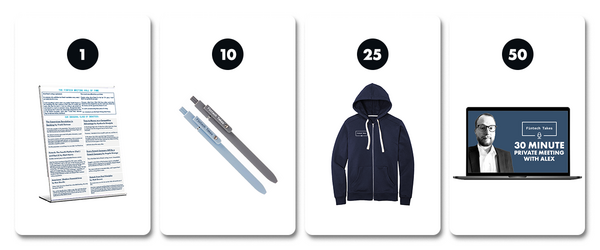
{if profile.vars.rh_reflink_11}  | Share with Fintech Takes, get cool stuff! | Have friends who'd love Fintech Takes too? Click the link below to share with your friends and get awesome rewards when they subscribe! | |
|
PS: You have referred {{profile.vars.rh_totref_11}} people so far | | Share Fintech Takes! | |
|
{/if} |
|
|
Get your brand in front of 55,000+ fintech and banking executives. |
Workweek Media Inc.
1023 Springdale Road, STE 9E
Austin, TX 78721
Want to ruin my day? Unsubscribe. |
|
|
|