Costco’s Asia Expansion
Let me hit you with some quick history.
The first Costco Wholesale warehouse opened in Seattle in 1983.
Co-founder Jim Sinegal had spent the previous 5 years working with the legendary Sol Price. For the uninitiated, Price is the absolute OG of the retailing industry. Sam Walton, Jeff Bezos and Sinegal have all paid respect to Price like today’s young hip-hop producers shoutout Dr. Dre.
Price was a pioneer of the membership warehouse model and launched Price Club in 1976. Sinegal worked at Price Club and took his learnings to co-found Costco, which was basically an instant success. In fact, Costco became the first American company to grow from $0 to $3 billion in sales in less than 6 years. In 1993, Costco merged with Price Club and the combined entity did $16B that year with over 200 locations.
The merged operation took the name Costco and its next corporate chapter included expansion into Asia including South Korea in 1994 and Taiwan in 1997.
Why Asia? Both locations had fast-growing middle classes with an appetite for Western products.
There were significant challenges to entering these markets, though. Bulk buying of stupidly oversized ketchup bottles and 48-packs of paper towels had to contend with the reality of smaller homes and less available real estate for commercial use.
The “Asian Miracle” development model — which involved significant government oversight — was a different operating environment for many foreign companies. It was also a challenge to navigate fast-changing land-use laws and zoning regulations.
According to the book The Joy of Costco by David and Susan Schwartz, Costco had to find local partners in these markets to break in:
South Korea is a prosperous country the size of Virginia, with a population of over 50 million. Dating back to the early 1950s when the US defended South Korea against invasion, Koreans love all things American. (There are still 15 US military bases in the country, so the servicemen and their families are also potential Costco members.)
Just as the Price Club / Costco merger was taking place in 1993, Price Club was concluding an agreement with the Korean retailing conglomerates Shinsegae; Shinsegae would own operations, while Price Club would license its name and run the operation. On October 7, 1994, the first Korean warehouse opened, in Seoul’s Yangpyung neighborhood, under the well-known Price Club banner — even though by that time, the Prices had left the merged company. At 94,000 square feet, Yangpyung is the second-smallest warehouse in the Costco system, with parking above the main retail floor.
In Taiwan, Costco sent a Taiwanese-American named Richard Chang, who had played basketball at UC Berkeley (dude could hoop). The local Taiwanese partner was President Group, which owned Taiwan’s first department store chain and definitely knew how to solve the land development hurdles.
More from The Joy of Costco:
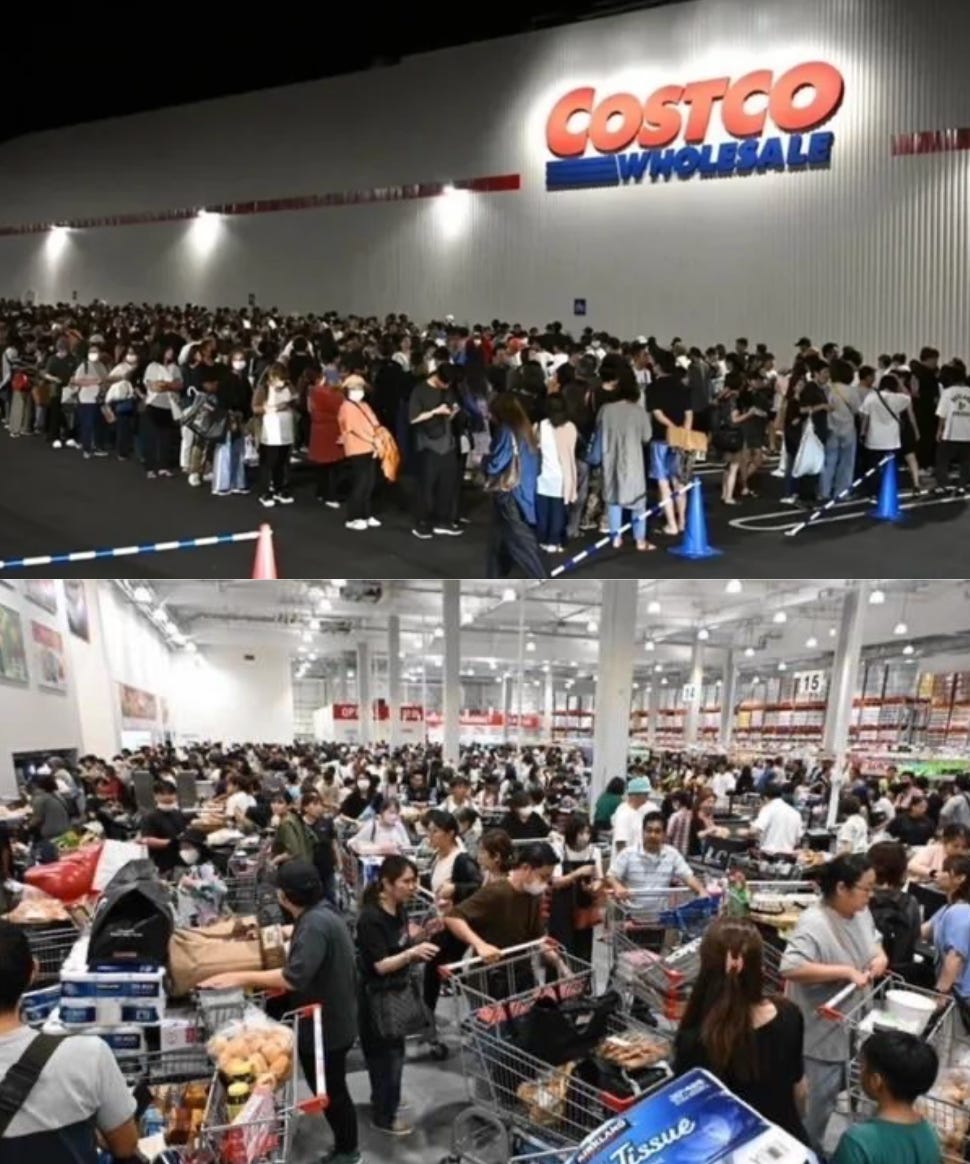
[Taiwan’s] highly mountainous terrain means that urban space is densely populated and priced at a premium. [Costco’s Taiwan] warehouses are multi-story, with multiple floors for shopping and several parking levels, either above or below the main shopping areas. Members travel between floors on included moving ramps, which lock the wheels of members’ carts to prevent slipping on the ramp.
The Taiwan location opened in 1997. Not the best timing. It was the same year as the Asian Financial Crisis.
A combination of too much foreign direct investment, lax lending and overheated real estate markets led to deep recessions across Indonesia, South Korea, Malaysia, and Thailand.
In South Korea, the country’s Won currency took a hit and imports became extremely expensive. This catalyzed Costco’s partner Shinsegae to sell off its majority stake. Costco completely bought out Shinsegae in 2017 (Taiwan’s local Costco partner fared better with the President Group holding a 45% stake in the joint venture until selling it all back to Costco in 2022).
With that context, let’s hop over to the main subject of this article: Japan.
***
The Japanese Opportunity (and Challenges)
While Japan took a hit from the Asian Financial Crisis — because Southeast Asia was a large export market — the country was spared the worst of the economic damage.
This isn’t to say that the Japanese government didn’t have financial pain. Japan was still dealing with the fallout from the bursting of asset bubbles at the end of the 1980s.
It was a decline of epic proportions as detailed by Vanity Fair:
At its height, in 1989, real estate in Tokyo sold for as much as $139,000 a square foot— more than 350 times as much as choice property in Manhattan. Such valuation made the land under the Imperial Palace in Tokyo notionally worth more than all the real estate in California.
The Japanese stock market, with some shares selling for a 1000x their earnings, similarly skyrocketed. Indeed, in 1989, the notional value of the stocks listed on the Tokyo exchange not only exceeded all the stocks in America but represented 44% of the value all the equities in the world. When the bubble burst — as all bubbles do —the real estate market lost about 80% of its former value, and stocks plunged about 70%.
As a result, the banking system that had extended virtually unlimited credit on collateral based on these assets was left, if not insolvent, paralyzed. To the extent that the heady prices of the late 1980s proceeded from a wild flight from reality, their fall represented a cruel regression to the norm.
Despite the economic crash, Japan was still the 2nd largest economy in the world — after America — when Costco eyed the market in the mid-1990s (around the same time, the country unleashed a powerful cultural mind virus for the population of under-30 American female: Hello Kitty).
Many shopping retailers had tried to break into the juicy juicy Japanese market but it was a mixed bag. Brands targeting a single industry (Toy R Us, McDonald’s, Office Depot) found success while more generalized shopping experiences (Walmart, Tesco, Metro, Carrefour) had flopped.
Japan’s retail market was even tougher to crack than either South Korea or Taiwan.
However, the Japanese government was willing to experiment with new ideas to jumpstart its economy (especially with the wave of changes coming from globalization and the rise of the internet).
Costco entered Japan by partnering with a local land developer (Torius) that was pushing the envelope on Japan’s land use rules.
As detailed in a 1999 LA Times article, here were some key issues that Torius tackled:
Tight Quarters: In the mid-1990s, Japan was “a cramped, mountainous [country with]…125 million people squeezed into an area smaller than California” and “most projects go high in the air and deep underground on small, cramped floors to make maximum use of the land”, so Costco had to adapt.
Converting farmland: Through agricultural co-operatives, Japanese farmers have a lot of political power. To entice farmers to turn rice fields into commercial space, Torius proposed to “lease rather than purchase the land, allowing aging local farmers to earn five times more money by signing a contract than they would straining their backs in their fields.”
Relaxing landlord requirements: Following the Japanese Bubble Burst and Asian Financial Crisis, shoppers and retailers were understandably conservative with their funds. Torius eased financial concerns by offering “flexible and relatively inexpensive terms to tenants, so that instead of shelling out a fixed monthly rental amount, for example, the retailers [could] pay Torius 10% of their sales.” Further, Torius charged “only limited ‘key money’, a nonrefundable fee most landowners [in Japan demanded] from renters that is somewhat analogous to points on a mortgage.”
The founder of Torius, Takashi Hirayama, told the LA Times, “With the collapse of the economy, the conventional way of doing business in Japan doesn’t work anymore. Japanese consumers are defensive, tightfisted and afraid of losing their jobs. This project is my response.”
Torius’ forward-looking approach was in stark contrast to Japan’s century-old business groups called keiretsus (eg. Mitsubishi, Mitsui, Sumitomo).
Perhaps the most important change was at the national level: the Japanese government relaxed a “notorious” large-store retail law (called "Daitenho") that had previously made it very hard for foreign competitors to enter the country.
Under this onerous regulation, large retailers had to “first gain the approval of every mom-and-pop store in a neighbourhood” and also “stay closed almost a month each year so as to be less of a competitive threat.”
Man, I can barely co-ordinate a WhatsApp group of 4 people to meet for a coffee at Starbucks a month from now. Can’t imagine wrangling dozens of mom ‘n pop stores that don’t even speak the same language.
To be fair, these large-store retail laws made sense when Japan wanted to protect local champions while re-building in the first few decades after WWII. But by the end of the 20th century, Japan was an economic juggernaut and deeply integrated into the global economy. Access to Japan’s market had become a sticking point for America….and remains one to this day if you’ve seen any tariff news lately.
Between Torius’ negotiating skill and a changing economic environment, the Costco warehouse discount model actually had a chance to succeed in Japan.
***