I needed to read up on the topic.
During the Concorde's development in the mid-1960s, the future of air travel was uncertain. The Concorde focused on speed and supersonic transport (SST), while Boeing made a big bet on its wide-body and very large 747 jet.
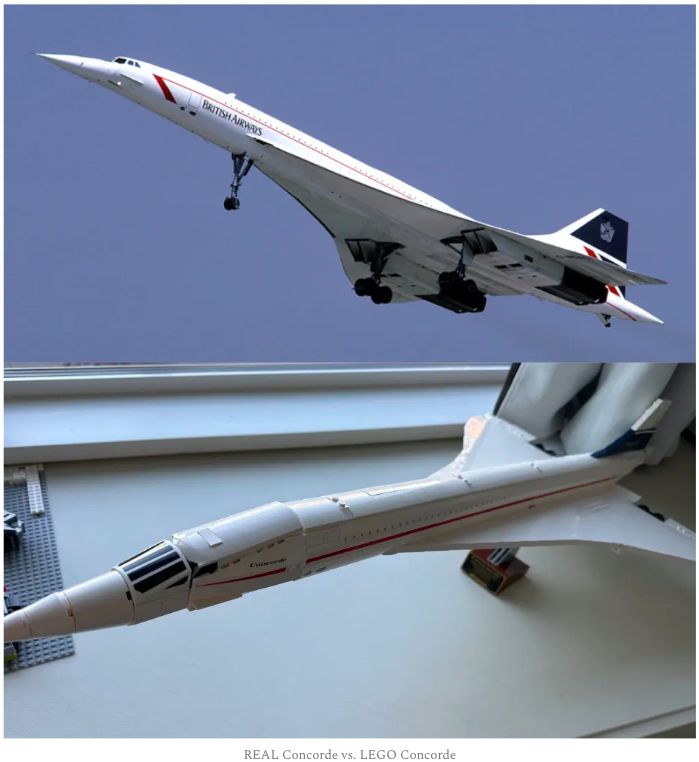
Here is something I wrote on Twitter after my son finished his LEGO Concorde:
***
The Concorde was a technical marvel.
Development began in 1962 and was a joint effort by Air France and British Airways (backed by their respective governments). It flew faster than the speed of sound and went from London to New York in ~3.5 hours (half the time of a normal airliner).
But the business economics were awful.
Let’s start with the insane specs (via this great engineering YouTube video):
- Got as high as 60k feet
-
Flew around earth in 30 hours
- Mach 2.04 speed (more than 2x speed of sound)
- Arrived in New York at an earlier time than it left London (banker types loved this feature)
- An ionic design including delta wings and and a nose tip that could down during landings (the plane had to land at a specific angle and it was the only way for pilots to see the runway)
The plane operated from 1976 to 2003 and the business had many obstacles:
-
Small Addressable Market: The thin aerodynamic design could only seat 109 people, so tickets were very expensive: $11k (a Boeing 747 can do >500 passengers)
-
Huge Maintenance Costs: Planes got so hot at the max height (110 degrees), that they expanded 30cm and sealant for fuel hardened. It took 28 hours to turnaround the plane (a normal plane can be turned around in <2 hours). This extra maintenance limited the number of times the Concorde could fly in one day.
- Outrageous fuel needs: Each flight required 28,000 litres, for max 109 passengers. Commercial planes needed 4x less fuel on a per passenger basis.
- Noisy AF: Many cities wouldn’t allow the Concorde to fly because of how glass-shatteringly loud it was on take-off (this limited potential destinations and the total market for the plane).
Development of the Concorde cost $2.8B and was paid for by the UK and French governments (the name ends with an “e” to placate the French). Air France and British Airways were actually able to fly profitably for a number of years. But the economics were warped because the planes were given to them for free and the airlines didn’t have to capitalize costs.
Ultimately, the Concorde fleet settled on only 14 planes and mostly flew the London to New York route (initial sales projections for the Concorde was >200 planes).
The business ultimately closed in 2003 following a tragic crash in 2000 and industry-wide slowdown post-9/11 (in a twist of history, the day that the Concorde was cleared to fly again following the 2000 accident was September 11th, 2001).
Will we ever have sub-4 hour flights from London to NY again? A batch of sonic plane startups are trying to solve the challenge — including one with the fantastic name of Boom — and could make it happen by the end of this decade.
***
This answer was sufficient for my kid at the time but I’m sure our visit to the museum will lead to many more questions. Fortunately, Brian Potter at the Construction Physics newsletter published an article titled “Why Did Supersonic Airlines Fail” on the same day I went to The Museum of Flight.
Turns out that Boeing actually started building a plane for SST in the 1960s but — as noted above — the economics were so poor that the US government didn’t want to foot the bill and the project folded in 1971. The city’s one-time NBA franchise (Seattle SuperSonics) was named after Boeing’s failed SST plane and it also suffered an ignominious end when the team was moved to Oklahoma City (Thunder) in 2008. It isn’t all bad news for the SuperSonics, though: I bought a fresh throwback SuperSonics hat while visiting The Space Needle on the trip and it is very likely that Seattle will get the NBA’s next expansion franchise.
The Soviet Union had more luck with SST and built the Tu-144, the only other supersonic jet to enter commercial service. Two notes on this effort: 1) economics mattered a lot less for the Soviets, who were more concerned with developing technology and national pride; and 2) they stole some plans from the Concorde project (the Soviet effort was nicknamed Konkordski).
The entire article is worth reading, but here are some additional Concorde-specific details:
France and Britain had different motivations to do SST: “In addition to sharing development costs, a partnership between Britain and France would help both countries. France would get access to British engine technology and the powerful Olympus engines that would make transatlantic supersonic flight possible; Britain would (it was hoped) be allowed to join the European Common Market, the predecessor to the EU…The agreement, critically, had no exit provisions, and had the status of international treaty: if either country withdrew, they could be sued in the International Court in the Hague, and be forced to pay hundreds of millions in restitution…But despite joining forces, the two nations were pursuing the SST project for different reasons. Britain wanted to maintain its faltering aircraft industry, and wanted a grand symbol of Britain’s engineering and technological competence that would enhance national prestige, keeping Britain relevant in a world that was becoming dominated by the US and the Soviet Union. France, on the other hand, hoped to become more independent from America by fostering technological development: an SST project would require expanding French capabilities in materials, machining, electronics, and a host of other high-tech industries. France also saw the project as a chance to enhance national prestige. Neither country necessarily expected an SST to ultimately be commercially profitable, though economic concerns would loom larger and larger in Britain as development costs spiraled upward and the chance of recouping its investment dwindled. Only the binding nature of the agreement kept Britain from withdrawing from the project”
The science of why supersonic flight is so difficult: “The fundamental challenge of supersonic travel is that air behaves very differently above and below the sound barrier, and different kinds of aircraft work best in each domain. At supersonic speeds, an aircraft works best if it's thin and needle-like, with narrow, swept back wings. But this sort of design has trouble providing sufficient lift at subsonic speeds. Similarly, different kinds of engines work better in each domain: at subsonic travel, a high-bypass turbofan works best, while at supersonic travel a turbojet is superior. This makes designing an SST difficult, because it will inevitably spend significant amounts of time in both domains: cruising at supersonic speeds, but taking off, approaching, and landing at subsonic speeds (not to mention when abiding by restrictions on sonic booms over land). Designing an efficient supersonic aircraft is like designing a car that can double as a boat: it's possible, but it's hard to make such a vehicle as cheap as a conventional car.”
The limits of infinite funding: Potter writes about the “push” strategy in technological development. Solar is an example of an industry where the government was able to invest large sums of money to “push” the industry down the learning curve and make it “economically competitive and widely adopted”. This approach didn’t work for the supersonic transport industry because “the fundamental physical constraints of supersonic flight have made it inherently noisier and more expensive than subsonic travel, which combined have doomed most commercial efforts, regardless of how many dollars were thrown at the problem.”
The Concorde project was often compared to NASA's Apollo mission. Neil Armstrong once remarked that “from a technical perspective...the Concorde was as big a challenge as putting a man on the moon.”
Ultimately, the 747 — which debuted in 1969 — had the correct model. To commemorate its 50th anniversary, The New York Post wrote about the jet’s dominance:
"The plane, which would soon be dubbed 'Queen of the Skies,' was big — maybe too big. At twice the size of the Boeing 707, it was by far the largest civilian passenger jet ever conceived: 231 feet long with a 196-foot wingspan — enough room to play regulation basketball on each wing — and a tail as tall as a six-story building. [...]
It was far from just a “good” airplane. The Boeing 747 would come to redefine air travel in the late 20th century. With its four engines, it could travel farther and faster than other jets and, with a seating capacity of 550, carry three times as many passengers. The extra seats meant prices for international travel came down, and a golden age of global tourism for the masses was born.
Between 1970 and 2017, more than 3.5 billion people have flown on a 747, more than half the world’s population, according to the Smithsonian. 747s have carried Space Shuttles for NASA, been the choice for Air Force One since 1990 and was Richard Branson’s first plane when he launched Virgin Atlantic in 1984. […]
When the Concorde failed to take over — carriers like Pan Am and TWA weren’t interested in a plane that used 11 times more fuel while carrying a fraction of the passengers — the 747 became the jumbo jet of choice."
The catalyst for Boeing's current struggle was the company's $14B acquisition of McDonnell-Douglas in 1997. Within a few years of that deal, Boeing went from being an engineering-focused company to an organization dominated by financial types and bean-counters who cut corners to eke out a little more profit. This unfortunate change in the company's DNA was especially evident when Boeing moved its headquarters from Seattle to Chicago in 2001 and the executive team was no longer physically located near the manufacturing facilities.
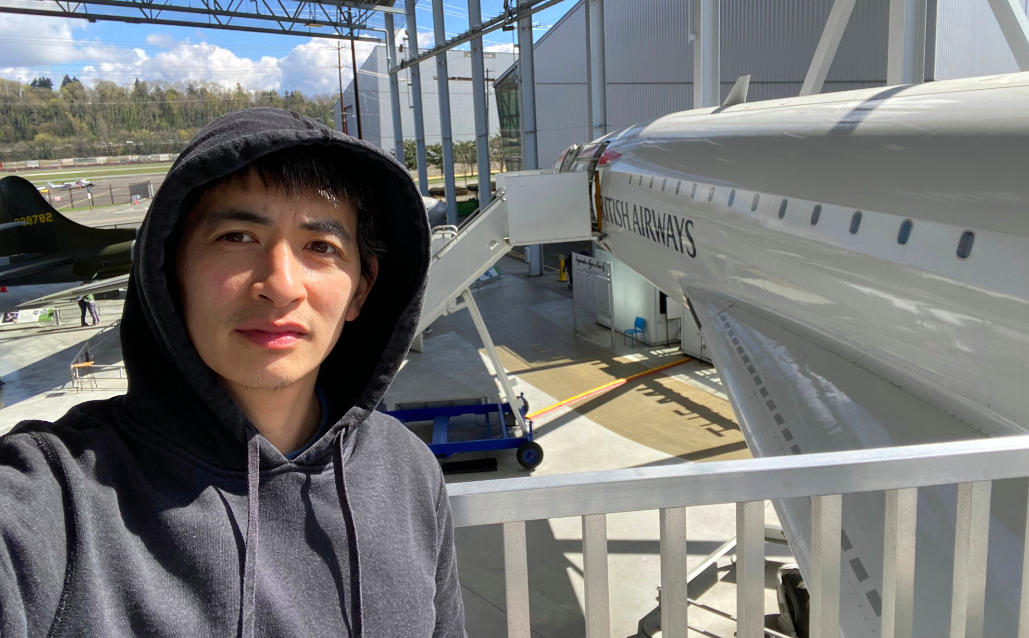
After snapping some photos with the pristine-looking Concorde, I left the museum hoping that my son would grow up with a Boeing that brought back its illustrious engineering roots.