Thierry’s craftsmanship was sought after by the country’s upper class including the wife of France’s leader Napoleon III (the OG Napoleon’s nephew).
The time period of Hermès’ founding is crucial.
Why? Think back to your high school history lesson.
The French Revolution — which began in 1789 and toppled King Louis XVI — kicked off decades of social change and war in Europe. The convulsions remade hierarchies, ushered in republics and affected every aspect of religion, education and commerce.
At the same time, the start of the First Industrial Revolution catalyzed the continent’s transformation from agriculture to industry and factories.
I’m glossing over a lot of history here but will comfortably state that these seismic events led to two massive changes relevant to the story of Hermès:
- The Determination of Status: For centuries, status in Europe was tightly controlled by the Church and Royals. From 511 until 1789, Catholicism was France’s state religion. The Revolution severed this tie (although France did not become a fully secular country until 1905). Combined with the rise of new power centres (e.g. industrialists), social hierarchies were completely re-ordered.
-
Beginning of social mobility:
Over the next century, living standards marched upwards and the possibility of movement between social classes was much more attainable. Through industry and commerce, people could aspire to different classes for themselves and their children. Furthermore, advances in textiles, chemicals, storage and logistics meant that an entrepreneur could manufacture — and spread new status signifier (e.g. garments) — to more people compared to small-scale home operations (otherwise known as the “cottage industry”, which is a term from the Industrial Revolution).
While old hierarchical arrangements or status signifiers are swept away, humans will always find a new way to rank order society. A passage from the business marketing book Luxury Strategy explains why:
“Since the dawn of humanity, there have been organized societies, leading groups and, of course, objects, symbols and lifestyles specific to these leading groups. It is in the appearance of these leading groups and of the symbols and objects specific to them that we need to look for the origins of luxury. If we accept this analysis, luxury is part and parcel of humanity and of life in society.”
Social signifiers have been well-documented across cultures and throughout history (Sumerian palaces, Egyptian pyramids, Roman Colosseums, Mayan jewelry, Aztec temples, and the inner courts of Chinese dynasties).
Europe during the 1800s presented an opportunity for new status signifiers in
To wit: LVMH currently organizes its 75 houses into 6 categories; in 5 of the categories, the oldest brands mostly date to the 1800s.
- Fashion & Leather Goods: Loewe (1846), Moynat (1849), Louis Vuitton (1854), Berluti (1895), Rimowa (1898)
- Perfume: Officine Universelle Buly (1803), Guerlain (1828)
- Watches & Jewelry: Chaumet (1780), Tiffany & Co. (1837), Tag Heuer (1860), Zenith (1865), Bulgari (1884)
- Selective Retailing:
Le Bon Marche Rive Gauche (1852)
- Other Activities: Cova (1817), Royal Van Lent (1849)
The 6th category is Wine & Spirits, which goes back as far as 1365 with winemaker Domaine Des Lambrays (humans have been getting hammered since drinking fermented rice and honey in China around 7,000 BCE, so it makes sense that alcohol brands go back longer than the other categories).
Unsurprisingly, LVMH website includes the indicator of "how old is this brand" as the key detail after the brand's name.
Age is important.
When looking at European luxury brands outside of LVMH, we have notable ones such as Hermès (1837), Delvaux (1829), Goyard (1792), Burberry (1856), and Crocs (2002).
These brands all sell "time" in the sense that recreating their centuries-long heritages today is impossible (if these brands continue to exist — and a time machine is not invented — basic math dictates that they will always be older than any new brands launched).
In the mid-1850s, Hermès was already considered the best leather-maker for European royals, specializing in horse saddles and harnesses. When the automobile revolution began in the 1920s and threatened the Hermès horse market, Thierry's grandson Émile pivoted the business towards luggage, furniture, handbags, men's clothing, jewelry, watches, scarves, sandals, and even special zippers (known as the Hermès fastener).
The focus on craftsmanship never wavered.
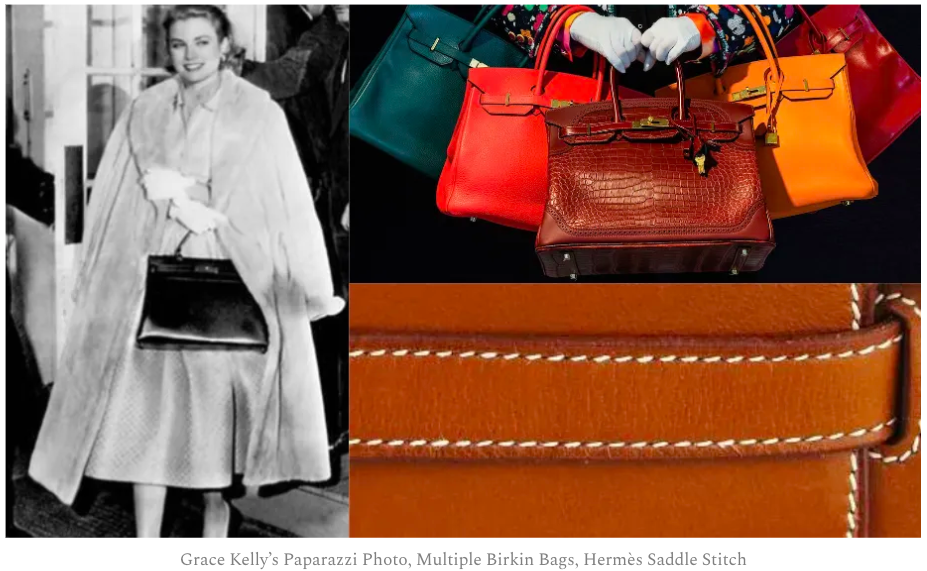
Nor did the connection to royals. Émile had four daughters and decided to pass the business onto his son-in-law Robert Dumas (hence, the Hermès-Dumas lineage). Dumas had designed the Kelly bag in the 1930s and it received the royal treatment in 1956 when iconic American actress Grace Kelly — married to the Prince of Monaco — was photographed with the bag covering a baby bump (unlike me, the Prince of Monaco rolled up into that Hermès store when Grace tapped him on the shoulder).
This history is all part of the “time” that Hermès is selling.
But there is more to it.
***
Another banger quote from Hermès CEO Axel Dumas is that his job is to “create desire”.
The best example of this is the mythical buying process for a Birkin Bag.
You can't simply walk into a Hermès store and ask for one. Instead, Hermès flips the buying process on its head and decides whether or not it wants to sell the bag to a buyer. This process certainly creates desire.
Here are some notable aspects of the Birkin Bag buying process and how “time” is leveraged at every step:
1. One-of-a-kind founding story:
In 1981, Jane Birkin — a British actress and “It Girl” from London’s Swinging ’60s — was sitting next to Hermès CEO Jean-Louis Dumas (Axel’s uncle) on a flight between Paris and London when he noticed her overstuffed straw bag. “You should have one with pockets,” he told her. “The day Hermès makes one with pockets, I will have that,” Birkin replied. “But I am Hermès,” Jean-Louis told her and soon ordered his team to make a variation on the Kelly Bag with a similar belt and lock closure. The Birkin debuted three years later and became an instant hit.
- Time element: The Birkin — like the Grace Kelly paparazzi photo before it — has a “founding” moment. Each bag’s lore traces back to that historic moment, which can not be replicated.
2. Rare craftwork:
The training to become an Hermès bag maker takes a minimum of two years (often up to 5 years) and the company only trains 200 people per year. Each Birkin bag is made entirely by hand and takes 20-25 hours to make. This process fits nicely with another Hermès motto: "We don't have a policy of image, we have a policy of product.”
- Time element:
Quite literally, these bags take a long time to make (Axel Dumas sums up his hiring process with this tale: “There is a German story about stonecutting during the Middle Ages and someone asks three stonecutters what they are doing? One of the stonecutters says, ‘I’m breaking rocks.’ The second one says, ‘I am earning my living.’ And the third one says, ‘I’m building a cathedral.’ The third one gets the job.”)
3. Managed supply:
The rigorous craftsmanship limits the Birkin supply. Hermès does not disclose the exact number produced each year, but it is estimated to be between 20,000 and 50,000 (and I would lean towards the lower end). In comparison, a more mainstream retailer like Coach sells over 1 million handbags annually. Also, Pierre-Alexis Dumas — the Hermès artistic director and cousin of CEO Axel — personally approves every bag that leaves the atelier, and any with even minor imperfections are destroyed.
- Time element: The aforementioned book Luxury Strategy noted that one of the key ratios in luxury is (# of people who know about product) divided by (# of people that can actually get the product).
With its managed supply, Hermès has a sky-high ratio — because the denominator is limited — and everyone in the numerator is left waiting. The wait for a Birkin can be up to 5 years. Per Vanity Fair
, long wait times have been a feature for Hermès since the beginning as “hand-stitched perfection cannot be rushed” and even “royal coronations were sometimes delayed until Hermès fittings for the carriage and the guard had arrived.”
4. Quality:
The Birkin Bag also utilizes top-tier materials, whether it's premium cow leather or crocodile skins (the company owns four crocodile farms in Australia). Paired with expert craftsmanship, the bag is designed to last a very long time and repairs are usually carried out by the original craftsperson.
- Time element: The Vanity Fair
article includes a great quote from Robert Dumas: “Hermès is different because we are making a product that we can repair. It's so simple. And it's not so simple. Think that you can repair something because you know how to repair it and why it has been damaged. You have the hands. Think that you can repair it because you want to keep it. And think that you can repair it because you want to give it to someone else." (hence, Birkin Bags pass between generations and across time
).
5. Stores battles over goods: Twice a year, a thousand store reps come to Paris HQ for an event called "Podium." During this event, Hermès HQ introduces new products, but does not reveal the number of Birkin bags to the store managers. The stores are aware that they will receive some
Birkin bags, but HQ requires all stores to stock items in every categories (shoes, watches, fragrances, scarves etc.). This ensures that the entire product line is showcased at each location. The consumer surplus from unmet demand for Birkin bags spills over into these other products, as customers "settle" for available Hermès items while waiting for the bag.
- Time element:
Stores don’t always get everything they want and have to wait which means they also make their customers wait…which is all about time.
6. You don’t buy; Hermès sells to you:
First-time shoppers — even very wealthy ones — don't walk into a store and ask for a Birkin. Hermès gives them the opportunity to purchase it. To be eligible for a Birkin, a shopper must have a relationship with the sales staff. The way to establish that relationship is to purchase some of the items mentioned earlier. This tiered buying approach psychologically connects a shopper to the Hermès brand.
- Time element: Hermès makes the customers “work” for the right to get a Birkin Bag. Think about that. Time is a much more scarce asset than money. And Hermès forces even the most well-off people to expend their time before they can get the bag.
Notably, Hermès doesn’t have a marketing department and doesn’t do traditional sponsorships with celebrities.
Having said that, its retail process is the best form of marketing possible and Hermès teaches every employee about how it works, per Forbes:
To instill this ethos in the company, all new employees are steeped in Hermès' desire-creating culture through three-day sessions called "Inside the Orange Box" (so named for the signature packaging) that trace the company back to Thierry Hermès and give a history of each of the product categories (or "métiers," in Hermès-speak, which is French for a trade).
Thus every Hermès employee can wax philosophical about the Kelly bag, the trapezoidal saddle bag from the 1890s that Axel Dumas' grandfather transformed into a women's handbag and that Grace Kelly made iconic. […]
The top case study at the "Inside the Orange Box" indoctrination, according to those who have attended, surrounds the Hermès Birkin bag. And rightly so. The Birkin, a chic cousin to the Kelly bag that runs from $8,300 to $150,000, embodies everything that keeps the Hermès brand so profitable.
The HBO show Sex & The City had a classic episode about how difficult it is to get a Birkin Bag and there have been books written on the topic as well.
The process creates such a strong desire that celebrities often love to show off their collection of Birkin Bags. think Cardi B, Jennifer Lopez, Victoria Beckham, or Floyd Mayweather on Instagram.
As discussed earlier, status signifiers will always exist. This basic human reality bring Hermès an incredible amount of earned media.
In sum: acquiring a Birkin Bag requires the consumer to embark on a multi-product purchasing journey that costs a lot of money and…wait for it…time.
***
During the early 2000s, LVMH’s Bernard Arnault secretly built up a 23% stake in Hermès. Arnault had earned the moniker “Wolf in Cashmere” by marrying 1980s Wall Street tactics with his timeless French understanding of luxury and was eye-ing the acquisition of a lifetime.
Hermès had floated 25% of the company on the French bourse in 1993 as a way to cash out some of the Hermès-Dumas family members. That moved exposed the company to Arnault’s ambitions (he was able to build the position through equity swaps, which hid his true ownership).
When Arnault formally reached out to the Hermès-Dumas clan in 2010, it sent a shockwave through the familial ranks, according to Bloomberg:
"For the fifth and sixth-generation Hermès owners, ceding their empire to a competitor would have been bad enough, but losing it to what they saw as Arnault’s flashy, marketing-driven group was 'revolting,' Patrick Thomas, who was Hermès’ executive chairman, said at the time."
For over a century, the Hermès-Dumas lineage had proven that they were capable of carrying the torch, as imbued in another company motto: "the way the grandfathers of our grandfathers did."
From a business standpoint, the results are undeniable. In the four decades since the release of the Birkin Bag, Hermès has seen its annual sales grow 140x from ~$100m to $14B.
To rebuff Arnault, about “50 Hermès descendants got together and unanimously agreed on the creation of an even tighter ring-fence”. The solution was a corporate holding structure that embedded time as a key factor. The family holiding company has the first right of refusal for any Hermès block sales and the family members agreed to the terms for decades.
In exchange for the lock-up, Hermès pays the descendants a combined dividend that has reached $1B a year (note: I would also be cool with a multi-decade lock-up for part of a 10-figure annual dividend).
Arnault backed off and LVMH now owns ~2% of Hermès while the Hermès-Dumas clan owns 67% (that’s a total fortune of ~$160B).
At this point, I hope I have made the case for why time — in various forms — the concept of time is so important to Hermès.
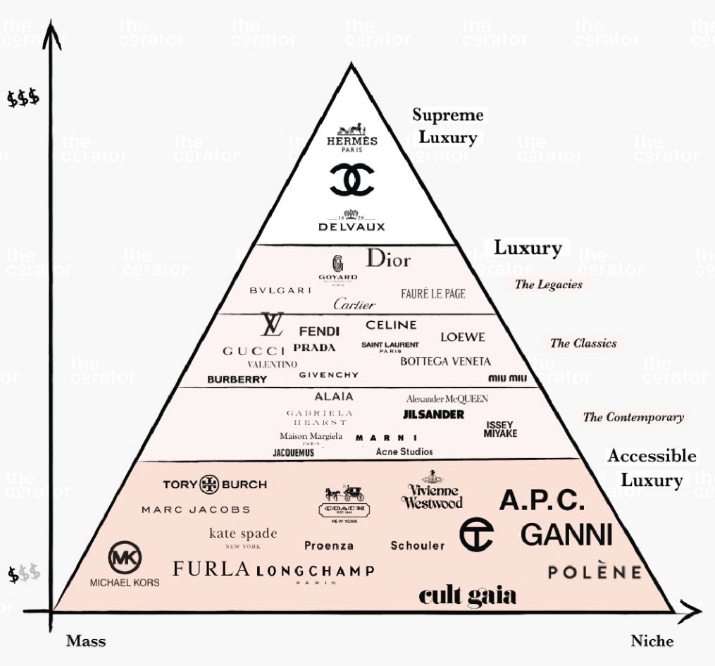
Remember the Luxury Bag pyramid from the beginning of this article?
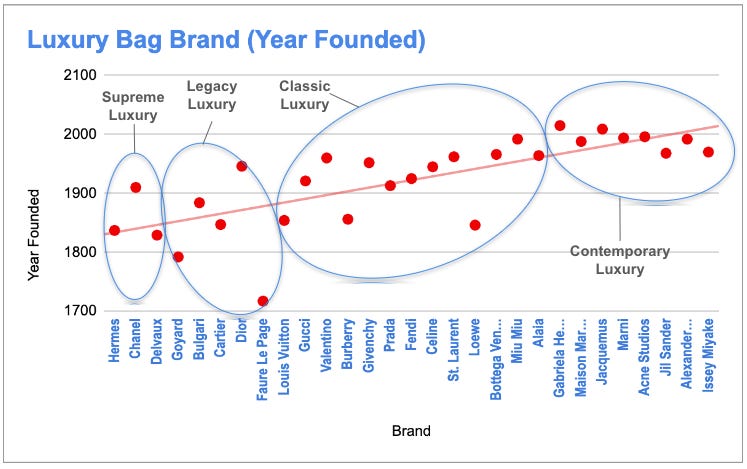
Below, I created a graph of the top brands by their founding dates.
It is not a perfect correlation but there is clearly a relationship between the perceived value of a luxury bag brand and how long it has been around.
My wife told me that Delvaux is rightfully #2. Founded in 1829, the Belgian bag-maker is the official luxury brand for the Belgian Royal Family and a favourite of the late Queen Elizabeth.
Hermès Birkin and Kelly bags still command a premium over Delvaux (to be sure, price alone does not define luxury: for example, if Old Navy were to release a $200,000 handbag, it would not be perceived as a luxury brand due to the absence of history and mystique).