Path Dependence
What is path dependence in technology?
It’s when a decision made in the past constrains future options and forces technological development down one path.
Here’s a simple example: today, the max tweet length is 280 characters.
Why? Because, in 2018, Twitter doubled the max tweet length that was set at 140 characters since its founding.
But why was 140 characters originally chosen?
Before the Twitter mobile app, tweets were delivered by SMS, which had a limit of 160 characters. So when Twitter was founded in 2006, the character limit was set at 140 (leaving 20 characters for the user name).
The max tweet size created a very unique platform: it rewards wit, brevity and humor but doesn’t allow for a lot of nuance (and leads to tons of snark and clapbacks).
However, there’s no longer any technological constraint on character limits and Twitter is finally rolling out some longer tweet formats.
My favourite example of path dependence in technology is on a much longer timeline than tweets: Did the the size of a horse’s ass in Rome determine the size of rocket boosters thousands of years later?
While the story has plot holes — which I’ll discuss later — it’s a great way to illustrate the larger lesson: understand what past decisions led to the current iteration of a product (and ask if it still makes sense).
Ok, so we’ll tell this horse/rocket story backwards.
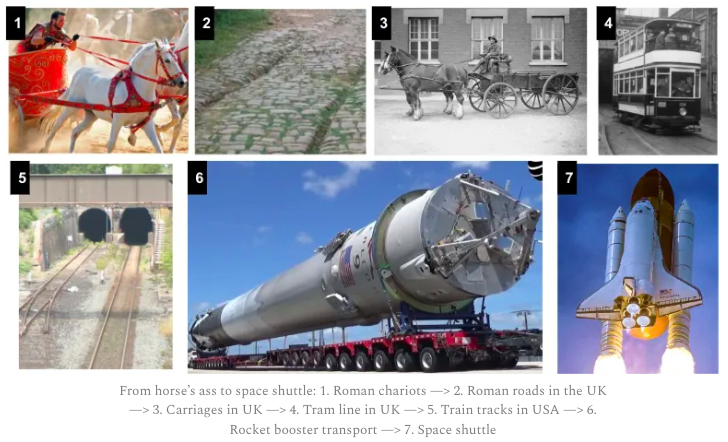
Let’s start in the early 1970s: When NASA developed rocket boosters for the space shuttle, it had to plan transport from the manufacturer Thiokol (Utah) to Florida (launch site). It did so by rail and had to make sure the rockets could fit through tunnels of a certain size.
The standard rail gauge in America is 4 ft 8.5 inches and the smallest tunnels on the route were not much wider than that. Why 4ft 8.5 inches? That track size was set in the mid-1800s as rail was laid across the country. The process was based on English building techniques.
What was the basis of England’s rail system? It was built to match the country's tramway tracks, which itself followed a horse and wagon system. The wagons relied on uniform ruts in the road (which could accommodate the wheels).
Now comes the connection to Ancient Rome.
English roads go back to Roman engineering, which made the ruts for chariot wheels.
What set the chariot width? Two horse asses side-to-side, which were in the ballpark of 4 ft 8.5 in.