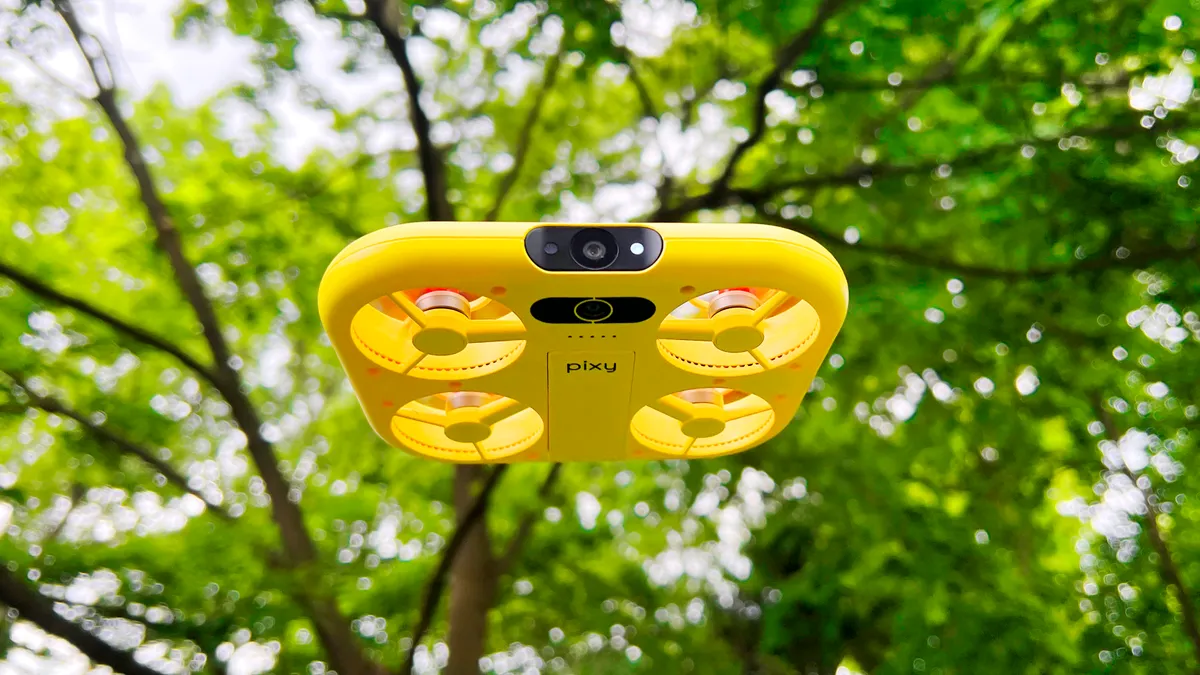
Good afternoon! It feels like big tech companies everywhere are looking for ways to expand and fend off slowing growth. For Chinese tech giants the next big market might be the US. SHEIN and Bytedance have already found massive success in the states and now Pinduoduo is hoping to follow suit. We dive into a few of the Chinese winners so far. Plus, VCs bet on Zoom’s demise, Snap kills the Pixy drone, and John Carmack is building the AI to end AI. And: Did you know Amazon wasn’t how Jeff Bezos made his first billion? |
Was this email forwarded to you?
|
|
|
Chinese Tech Giants Size Up the States |
How the tables have turned. For years American tech companies have eyed Chinese markets hopefully — and been summarily shut out. Now Chinese tech giants are looking to the states as an avenue to fuel their own halting growth.
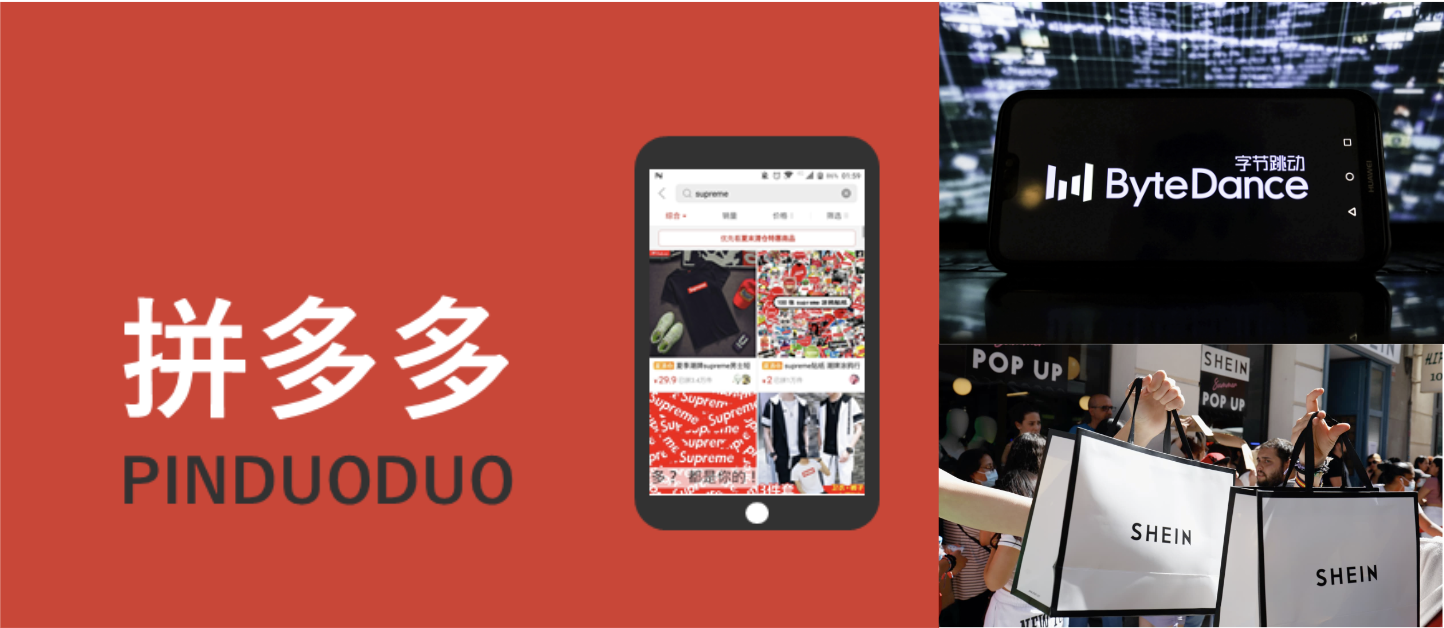
The difference of course is that US markets are wide open. SHEIN and Bytedance’s TikTok have already found massive success in the states. Now Pinduoduo has announced it’ll launch in the US later this year. |
Pinduoduo: Farm to Consumer
Pinduoduo is China’s largest ‘group buying’ platform. Consumers team up to buy products in bulk directly from farmers and manufacturers to get steep discounts.
For example, consumers can buy produce from a farm at 40% the grocery store price, cutting out the middle man. The catch is that they have to buy a lot of produce. Not quite a literal ton but close. Entire towns often band together into teams to buy in bulk.
Blitz Scaling: Incredibly, Pinduoduo was the fastest company to ever reach a $100B market cap. Founded in 2015 it reached the $100B mark in less than 5 years, at the peak of 2020’s pandemic ecommerce frenzy.
For comparison, it took Microsoft 25 years to hit a $100B market cap and Google and Facebook more than 12 years. Pinduoduo’s valuation is down to $63B now but in 2021 it generated $14.7B in revenue. |
Multiplayer: The network effects built into group buying are at the core of Pinduoduo’s lightning run to $100B. You can buy a product for full price on Pinduoduo but to get it for north of ~40% off you need to do is get 10 or 20 people to join your team and buy that same item. Since you’re buying things everyone needs anyway, like groceries and paper towels, and since everyone is getting it 40% off, everybody wins. For Pinduoduo, every person a user invites to a group buy team becomes a buyer. It’s like the virality of Zoom combined with the cost savings of Costco.
But will it work in the US? The biggest barrier to entry in the US is shipping. China has hundreds of third-party logistics companies that compete to ship products to every corner of the region.
The US has the UPS, FedEx, and the Postal Service. They’re slower and more expensive than Chinese logistics companies that operate more like Amazon Prime: overnight shipping, extremely cheap.
How Pinduoduo will overcome the shipping problem and whether American’s will adopt the ‘group buying’ concept remains to be seen. |
SHEIN: Ultra-Fast Fashion
Further along than Pinduoduo on the journey to the US is SHEIN. SHEIN is direct-to-consumer fashion retailer out of China that sells exclusively in the US. In 2020 they did $10B in revenue. |
Instant Clothes: Fast fashion retailers like Zara can design a new piece of clothing and have it manufactured in 4 or 5 weeks. The fast turnaround times mean inventory costs are lower and there’s always something new on shelves.
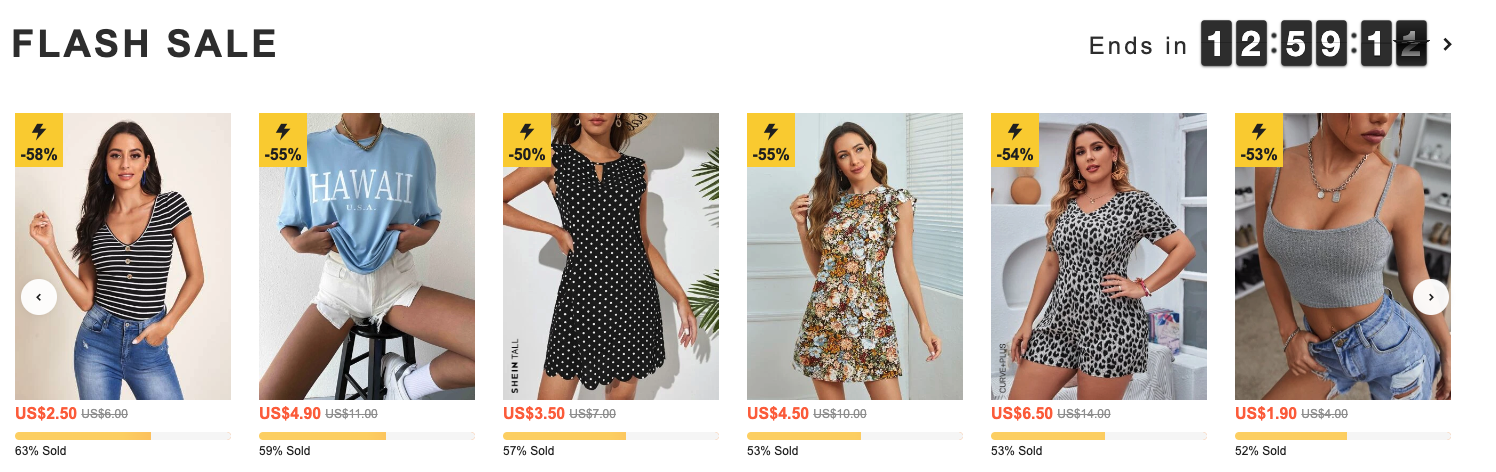
SHEIN is ultra-fast fashion. They launch 1000 new skews on their website every day. The timeline from new design to shipping to customers is less than 5 days. |
The key is super flexible supply chains, the culmination of decades of Chinese investment in textiles manufacturing, specifically in Shenzen. SHEIN can effectively make products as they are ordered by customers, making them one of the first retailers with zero inventory risk.
On the consumer side, SHEIN’s marketing and entire brand presence exists solely on social media. They have 25.7M followers on Instagram and use targeted ads extremely well.
Plus, the clothes are ridiculously cheap. They’re also undeniably low-quality but with dresses and swim suits and jeans selling for under $7 consumers don’t seem to care. At $10B in revenue with zero stores SHEIN might be the best DTC consumer brand of all time. |
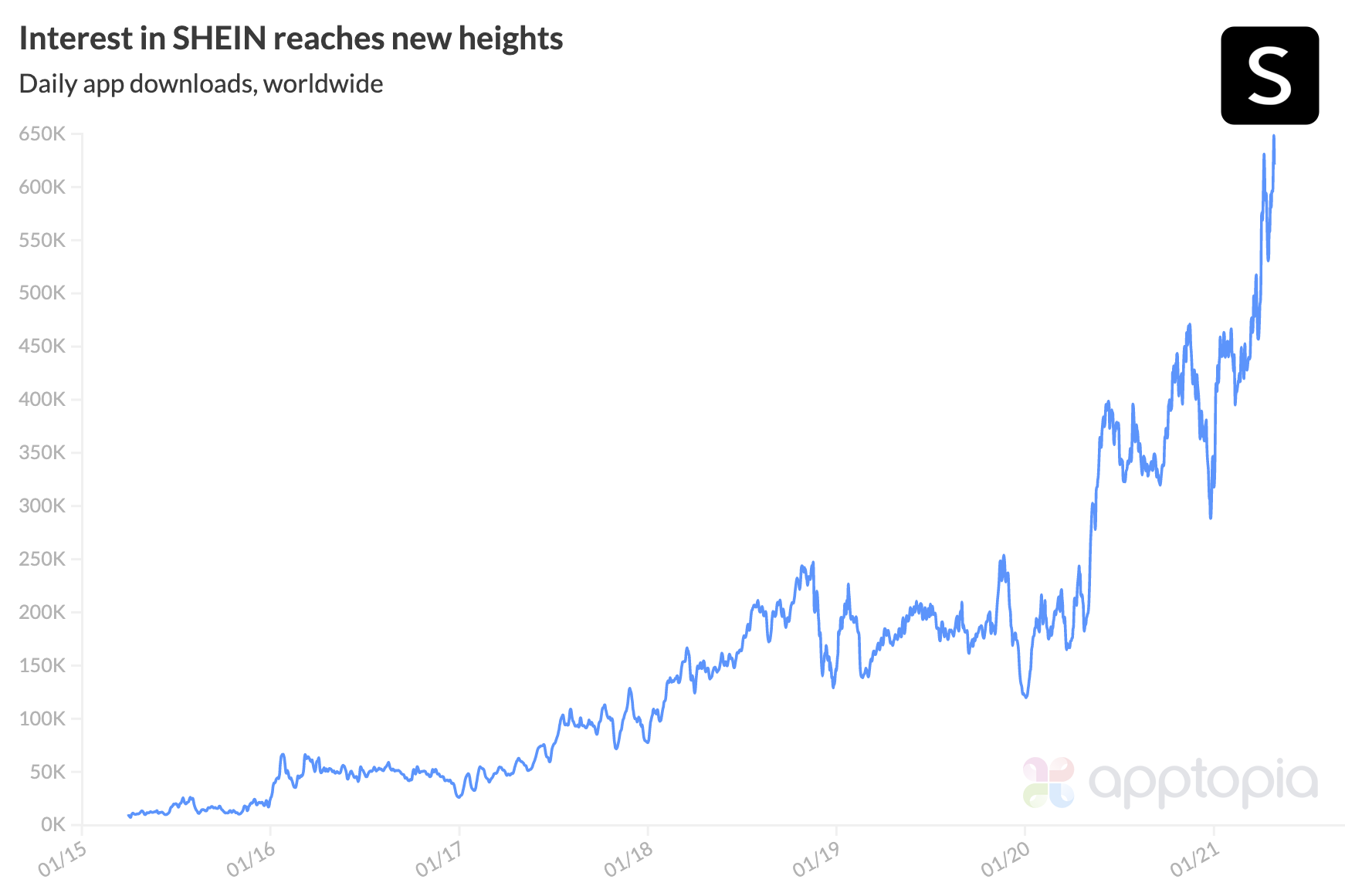
SHEIN’s daily app downloads through 2021. From Apptopia.
Bytedance: And of course you can’t forget TikTok. While consumers and legislators in DC have been preoccupied with tearing Mark Zuckerberg to pieces, a Chinese company has won the hearts, minds, eyes, and attention of America’s youth.
What to do? Is it fair that Chinese companies can tap US markets to fuel their next stage of growth while Chinese markets remain closed to American companies? No. But free trade has been a cornerstone US policy since World War II. With the exception of Huawei and the handful of Chinese telecoms giants the US has banned from its shores, that principal apparently still applies.
Even to the US’ greatest rival. Or if you prefer your glass half full, its greatest trading partner. China is both. So is Pinduoduo coming for Amazon like TikTok is challenging Facebook? I wouldn’t bet against Amazon but we’ll see. |
|
|
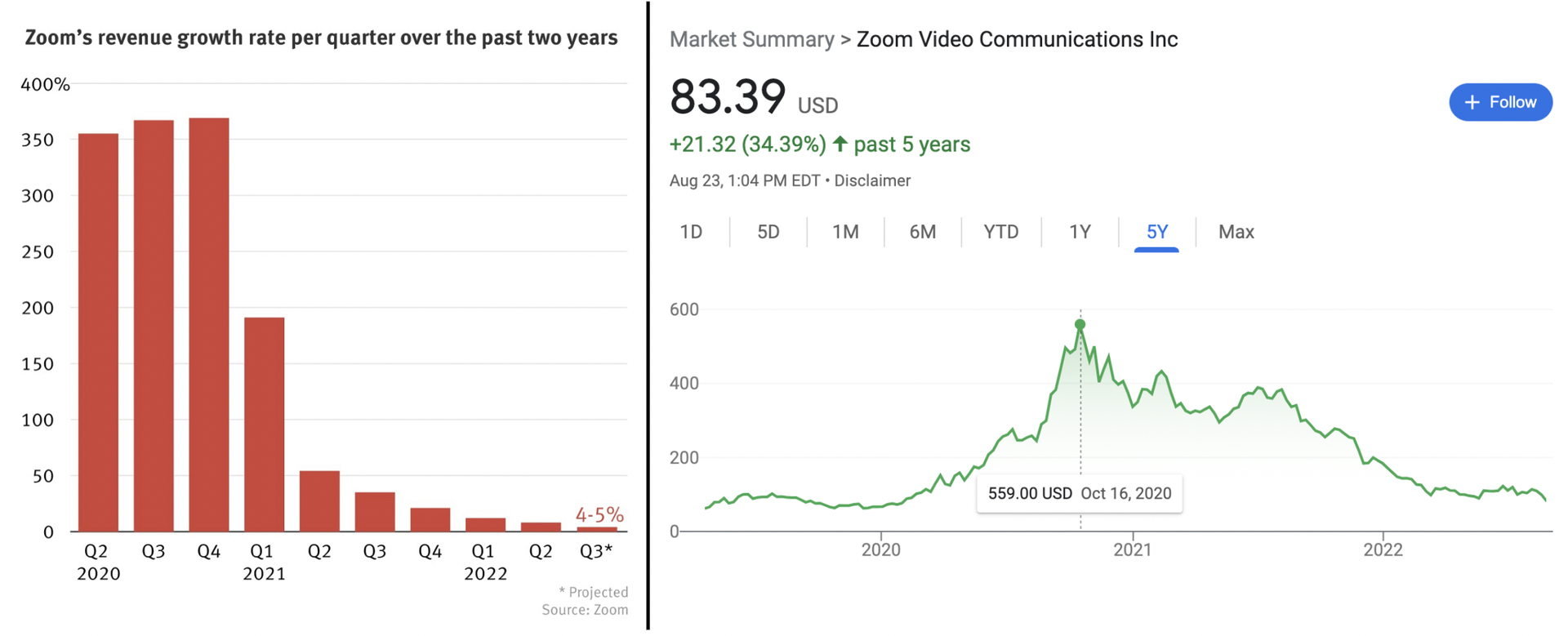
Zoom is way down. The SaaS giant just missed earnings and is expecting just under $4.4B in revenue for 2022. That’s only 7% growth, not great for a growth stock. Which may be why VCs are pouring capital into a new generation of video communications startups. |
On the left, a graph of Zoom's growth rate which plumetted from 350% a quarter in 2020 to 4% in Q3 2022, per The Information. On the right, the stock. Zoom 2.0
Just this week Venue raised $4M from Accel and Stewart Butterfield, the founder of Slack. The product is essentially Zoom with a better UX and Slack-esque features specifically built for all-hands calls and team meetings. In an interview with TechCrunch one of the founders called Zoom ‘the Craigslist of video conferencing’. Venue isn't the first. Other Zoom 2.0 startups have raised far more:
Mmhmm and Founder Phil Libin raised $35M from Sequioa and then $100M from Softbank’s Vision Fund. I also had an awesome conversation with him about product design on the Just Raised podcast.
Switchboard is a browser native webapp where you can collaborate on anything from Jira to Salesforce, effectively making any app multiplayer. It also incorporates video conferencing of course. Founder Amir Ashkenazi and I dove into Zoom and Product Led growth on the pod.
Gather has raised $76M from Sequoia and YC’s Continuity Fund to combine Zoom with 2D gaming. More than 10,000 teams have signed up to build virtual offices in a world reminiscent of ‘90s era Pokemon games.
There are dozens more. The playbook for all of them seems to be: a targeted use case, unique features, and video conferencing as a component of the product but not the entire product. |
A demo of Gather’s gaming-inspired virtual offices.
The Netflix Trap? It’s hard to imagine any of these companies displacing the verb that is Zoom.
But for all of Zoom’s brand recognition it lacks a moat. Like Netflix, the streaming technology is excellent but not impossible to replicate. It has a huge base of users but there are a lot of near identical products hoping to steal marketshare.
It wasn’t too long ago that Netflix was firmly in FAANG territory. Now that the market has caught up and everyone from Amazon to Disney has streaming… Netflix is in a tough spot.
With growth slowing to a crawl and a new spate of competitors hitting the market, you could make the case Zoom’s position looks a lot like Netflix’s right now.
Takeaway: Zoom isn’t going anywhere. It’s the standard and ‘return to the office’ is a much bigger problem than competition. But that may change.
Maybe video conferencing will evolve into a feature of every product. Maybe niche tools built for specific kinds of meetings will win out. Maybe we will finally start doing meetings in VR. |
|
|
Raise: $20 million from Sequoia
Including: GitHub CEO Nat Friedman, Stripe co-founder Patrick Collison, and Shopify co-founder Tobi Lütke One Liner: Artificial General Intelligence, aka the Singularity |
Narrow AI is the AI we know today — different algorithms specifically trained to recommending TikToks or identify a cat in a photo or win at Chess.
Artificial General Intelligence is like the Terminator or a new species. Better or on par with humans at every conceivable task. It’s a complete fiction right now but John Carmack believes it’s coming and Keen Technologies is going to try and build it.
With recent advances like GPT-3 and DALLE-2 AGI does feel closer. GPT-3 learned how to code and do math by ‘reading’ the web. What else could these big models learn? |
Raise: $9M from Launchpad, Accomplice, Menlo Ventures One Liner: Crypto trading with 0% commission |
Rocketplace looks like a Coinbase clone but with 0% commission to buy and sell crypto. Sure, you can grow a user base by competing on commissions but where does revenue ultimately come from? What’s the long term strategy? Rocketplace is building the crypto equivalent of index funds, ETFs, mutual funds — all kinds of financial bundles. DeFi desperately needs a well designed front end to bring on new customers so this isn’t a bad idea, although competition will be fierce. |
|
|
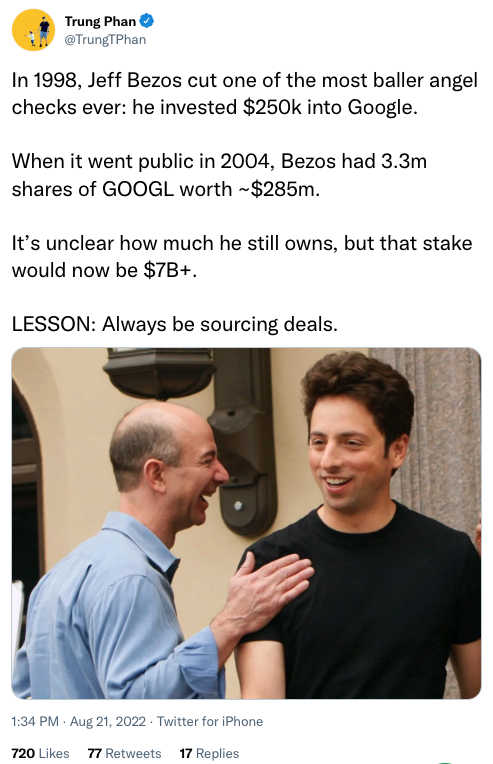
ONE FUN THING: Jeff Bezos’ Investment in Google |
The Acquired podcast recently did a fantastic breakdown of Amazon and Trung pulled out this incredible story of how Bezos first became a millionaire. It wasn’t from Amazon, it was from a $250,000 investment in Google.
That investment 1140xed in 6 years. Not bad. |
|
|
Thanks for reading. I’d love to hear your feedback if you loved it, liked it, or hated it — let me know. See you next time, Joe |
|
|
Want your message in front of 10,108 entrepreneurs and investors? |
Workweek Media Inc.
2952 Higgins Street
Austin, TX 78722 Unsubscribe. |
|
|
|