Good afternoon! Today we're diving into Adam Neumann's return to headlines, which is as flashy as you'd expect from a man who inspired an Apple TV show and presided over the fastest destruction of $40B in business history.
We're also circling back to talk about Axios $525M acquisition and asking the question: Why haven't VCs invested more in media startups? |
Was this email forwarded to you? |
|
|
Adam Neumann Raises $350M for Flow |
-
Adam Neumann, former WeWork founder, returns to headlines with the announcement of his new housing startup, Flow
- He just raised $350M from Andreessen Horowitz at a $1B valuation
- The $350M check is A16Z’s biggest single investment ever and Marc Andreessen is joining the board
Joe’s Take: Flow is just WeLive, but this time it’s going to work. |
Adam Neumann Returns
Marc Andreessen once called Adam Neumann ‘the best salesman I’ve ever met’.
As CEO of WeWork Neumann built an $8B real-estate business that transformed offices. He did away with cubicles. He put coffee and kombucha and craft beer on tap. He built the defining brand in co-working and had an IPO planned at upwards of $50B.
Then as you probably remember or saw on Apple TV, it came crashing down. Within hours of the S1’s release public investors pulled out, spooked by invented accounting metrics like the now famous community-based EBITA. WeWork’s valuation collapsed, settling at $8B, and the board ultimately paid Adam a $1B exit package to leave. But, he did build an $8B business and global brand. |
Venture Backed Housing?
Marc Andreessen has been circling housing for some time. Housing is one of the largest markets in the US but it’s been virtually untouched by tech. That makes it one of the last big markets left for startups to tackle.
But that’s not by accident. Housing asset heavy, there’s no software component, and there isn’t a whole lot of ‘innovating’ that can be done on apartments. Yes, there are 1,001 fintech’s innovating on how to finance a house but that's just financing.
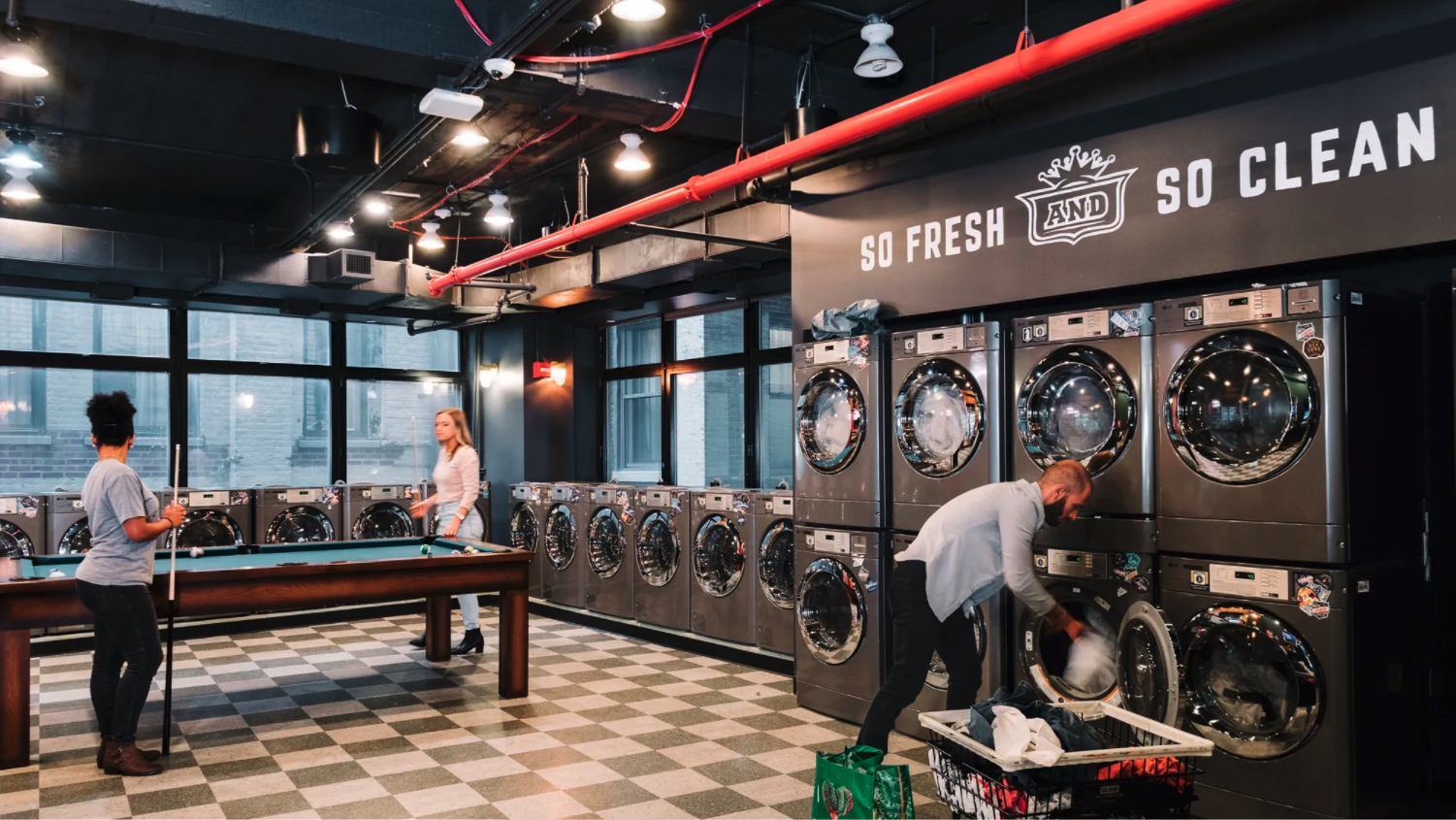
At the same time, one of the most laughed at facets of WeWork was Adam’s attempt to build a school and micro apartments with shared living space in NYC. The latter was dubbed WeLive and offered community focused housing that emulated a college campus for young tech workers.
And yet, Flow just raised $350M for what appears to be a clone of WeLive. Hmm. Photos from WeLive’s micro-housing development in NYC: |
WeLive 2.0 Flow is a bet that if you relaunched WeLive as a standalone business today it would work. It’s been 3 years since WeWork’s IPO collapse and a few things have happened since 2019. The key trends are: - A massive shift to remote work created by COVID
-
An exodus of tech employees from Silicon Valley, matched by A16Z, Sequioa, and other top firms who have expanded to new geographies or gone 100% remote
- A wave of investment in ed-tech and a wave of homeschooling, both as a choice and because of school lockdowns. This is a pet issue of Marc Andreessen’s
-
Rise of membership clubs and decentralized communities. This trend is mainly in Web3 but a ridiculous number of private clubs that have popped up to challenge Soho House
- Fintech plus housing has unlocked new
rent-to-own financing models pioneered by startups like Divvy Homes and Up&Up
If Neumann just builds high-end condos with WeWork-quality design he’ll make money. But since Marc Andreessen joined the board and the valuation is so large I’m guessing Flow will capitalize on a few of these trends.
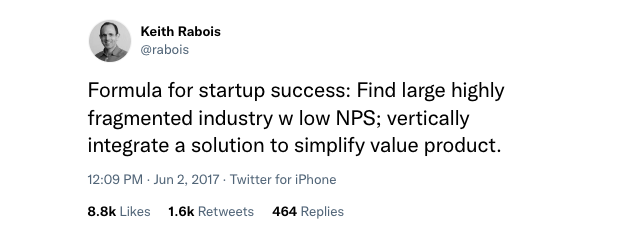
Plus, there’s always the Keith Rabois model for building a generational company: |
Housing is definitely fragmented and it’s safe to say customer satisfaction is at an all time low.
Takeaway: Flow will probably start small. High-end condos with WeWork vibes for a wealthy slice of slice of the consumer market: tech employees.
I’d bet we’ll also see a rent-to-earn component and over time token-powered private membership clubs. New childhood education models could come next.
But what do you think? Is WeLive 2.0 a good idea or is A16Z losing it? Hit me up on Twitter. |
-
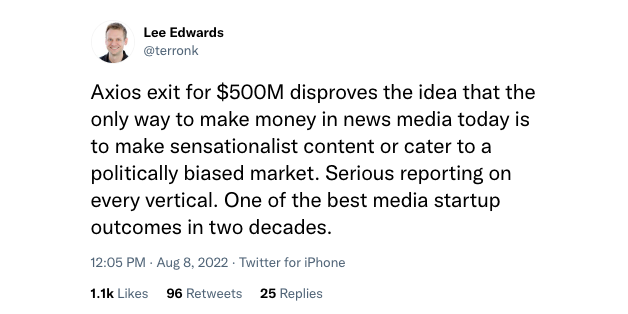
Axios news was acquired by Cox for $525M in one of the largest exits for a VC backed media startup to date
- Axios predicts it will reach $100M in revenue for 2022, primarily in ad revenue
- The acquisition includes a $25M investment into Axios Local, their local news division. Effectively a local newspaper delivered to your inbox.
|
Good News and Media Startups
Not only did Axios get acquired for $525M this month, just a few weeks ago Industry Dive was also bought for $525M. Both were media companies focused on high-quality business news for a niche audience. Which makes me feel great about Workweek’s thesis. But it’s worth noting that Axios was an outlier from a VC standpoint. Having raised $10M, $20M, and then $27M from 2016 to 2019, they raised far more than most up and coming media companies.
Morning Brew, which was just acquired for $75M, only raised $750,000. Industry Dive raised even less. The Information hasn’t raised at all.
Barstool raised only $5M in 2018 before getting acquired at a $463M valuation. Which made me wonder: Will we see more VC investment in media startups? And why haven't there been more already?
Platforms VS Media Companies
At the core, it's a costs problem. Yes, $500M exits are fantastic but VC backed software companies are regularly valued at upwards of $1B, with only a fraction of the $100M in revenue Axios had. Media and software polatforms have two key differences:
Content Costs: Facebook, Twitter, TikTok — none of the big platforms pay users for content on their sites. They’re all UGC or user generated content platforms. Content is free.
Media companies on the other hand have to invest in reporters or creators to create every single piece of content, like this newsletter or Axios’ HBO show, all of which costs money. That spend often makes media companies more suited to private equity than venture capital since PE firms often have funds designed with lower returns in mind. Scale: Once you’ve hit TikTok or Netflix or Amazon scale you can flip on ads and start generating revenue instantly. Smaller media brands like Axios and the Information lean on sales teams to sell ad spots to advertisers, which also bears more costs than platforms’ self-serve model. If you missed my deep dive into ads on Friday, it breaks down exactly this. Takeaway: VCs will jump at the chance to back new UGC platforms that can vacuum up free content from users but Axios and other media companies prove there’s still a path for niche, high quality news to build excellent businesses. |
|
|
Raise: $100 million Series D at a $500M valuation from Liberty Media Including: Blackstone, Bezos Expeditions, A16Z, Spark Capital, and 6% of active NBA players One Liner: High school sports highlights on social and new leagues for top students |
Overtime is a new kind of media company building an empire out of high school sports. They started with highlights on social media and now have launched two new sports leagues for top student athletes, complete with 6 figure contracts.
Their social channels have blown up with over 65M followers and 2 billion views a month. That alone is the makings of a new media business, but with the new basketball and football leagues they’re going vertical. By owning the leagues and the pipeline to pro-sports they position themselves as a complement to pro leagues instead of a competitor and potentially, talent management for some of the best up and coming players in sports. Backer Liberty Media isn’t a common name in VC circles but they’ve been key to the rise of Formula 1 over the past few years, which makes this deal even more interesting. |
Raise: $7 million Seed from Lux Capital
Why Now?: Commodities like wheat, oil, and copper are skyrocketing due to conflict in Ukraine, climate change, and COVID related breakdowns in global supply chains One Liner: Online market for commodities traders |
Incredibly, the commodities markets still exist mainly on paper. The $30 trillion in physical commodities and their derivatives traded each year, happens offline through a series of brokers. Actual shipping of commodities happens in massive open top ships like the one above, called break bulk shipping, and contracts are negotiated by hundreds of independent shipping firms.
Vosobor is trying to tackle the global agricultural commodities shortage by bringing the market online. Digitizing trading would make these markets more accessible, and hopefully, cheaper and more efficient. If it works farmers will be able to sell futures contracts to hedge against future profits and fewer agricultural products rot sitting at port instead of getting delivered to people who want to buy them. |
Raise: $4.2M from NEA
Including: A16Z Games Fund I One Liner: Player created AI bots for gaming |
Regression made a game out of building AI to play games.
The purpose of Regression isn’t to play a game yourself but to build an AI to play it, like the AI that beat humans at chess, go, poker, and Starcraft. The founder describes it as a new kind of gaming at the intersection of no-code product development and gaming. He hopes players will discover how to build better AI enemies for games. A16A General Partner James Gwertzman, hinted at bigger aims, saying Regression could lead to ‘frameworks to simplify AI bot creation’. In other words, player-built AI could one day be applied to all sorts of industries. |
|
|
This Reddit channel. That is all. |
|
|
Thanks for reading. I’d love to hear your feedback if you loved it, liked it, or hated it — let me know. See you next time, Joe |
|
|
Want your message in front of 9,753 entrepreneurs and investors? |
Workweek Media Inc.
2952 Higgins Street
Austin, TX 78722 Want to ruin my day? Unsubscribe. |
|
|
|